
Engineers and computer scientists have spent the better part of the past 15 years trying to integrate mobile phone technology into clothing. The closest example of these so-called “smart clothes” becoming a retail reality came in 2017, when blue jean behemoth Levi teamed up with Google to release its Jacquard trucker jacket. On the surface, it looked just like the iconic denim original, but its cuff had touch sensors and haptic feedback built in. By fiddling with those inputs, wearers could control aspects of their connected smartphone like pausing and and skipping forward music, receive vibration alters or even remotely snap a photo, all without ever having to stop and look down at the phone’s screen.
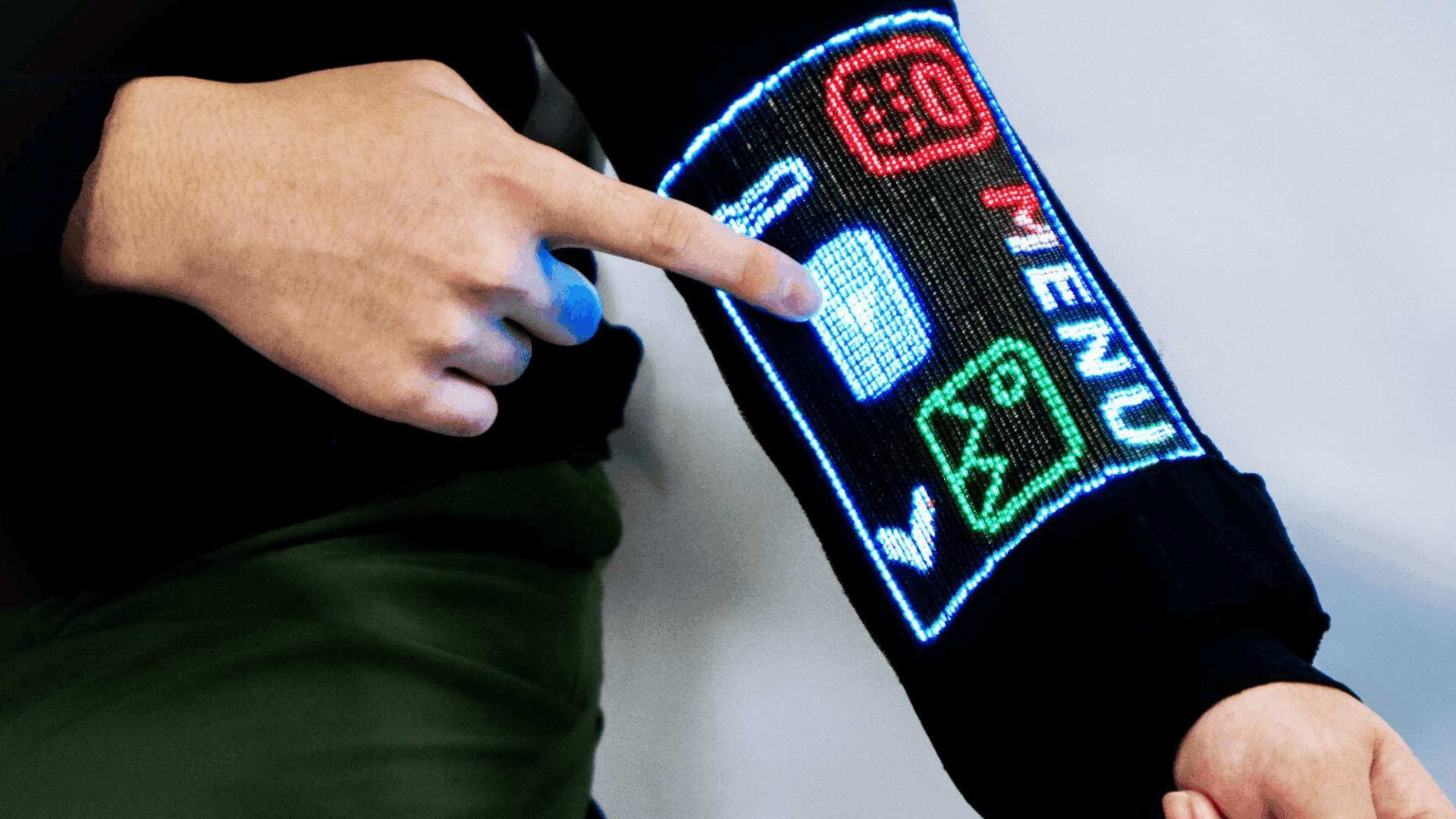
Jacquard was a technological leap, but its relatively simple input system meant its uses were incredibly barebones, andGoogle eventually shuttered Jacquard in 2023. For smart clothes to meaningfully “replace” a mobile phone, the clothes themselves would need to function as a screen. That challenge has proven far more daunting, but a team from National University of Singapore college of Design and Engineering believes it has taken significant steps forward with what it’s calling the world’s first touchscreen built into a garment. They managed to pull this off by engineering a flexible, wearable fiber made up of 54 electronic fibers that functions like a digital image pixel. That fiber can be weaved into clothing to create a space on the user’s forearm that looks and functions like a smartphone screen.
In testing, researchers wearing the touchscreen shirt connected it to their phones, and used it to scroll through photos. This shirt/screen hybrid also played videos at 30 frames per second, which isn’t exactly right for top-tier viewing, but is certainly passable. The team were also able to tap on the touchscreen shirt to check notifications and use its Bluetooth connection to issue voice commands. It can even run the calculator app. Talk about some back-of-the-hand math.
The touchscreen shirt isn’t ready for mainstream use yet, but it offers one of the clearest templates yet for how smart clothes could pull increasingly distracted brains away from smartphone screens.
The team published their findings recently in the journal Nature
“What made this possible was our ability to construct the GUI system from electronic building blocks in fiber form—similar to traditional yarn, but with the sophisticated electronic functionality built directly into the fibers,” National University of Singapore college of Design and Engineering assistant professor Tural Khudiyev said in a statement.
Turning LED light strips into bendable textiles
Turning fiber into a relatable digital input isn’t easy. The team set out to develop a method for creating connection points along tiny insulated wires right where each accompanying microchip would need them. They used a laser light to precisely guide molten solder, a process used in circuit board manufacturing that ensures melted metal only bonds at precise points along the wire. The resulting strip of LEDs was then drawn into a multilayer thread one one millimeter thick, which is thinner than a credit card. In total, the team says it integrated more than 5,000 chips through more than 20,0000 electrical components into the fabric.
Each thin fiber is made up of a panel of tiny touch sensitive LED lights. Image: National University of Singapore.
“A fiber has a one-dimensional, axially symmetric geometry, which makes it difficult to build complex circuitry using approaches developed for conventional two-dimensional electronics,” Khudiyev added. “We overcame this limitation through a new interconnection architecture, which enables thousands of microelectronic devices to be integrated and interconnected along a fiber.”
Once fully woven into a garment, the smart fibers form a 6.6 by 4.3 inch display screen. The screen itself can register several touches at once and supports 8-bit color depth, which gives it a kind of a shimmering visual profile somewhat reminiscent of late 1980s and early 1990s arcade video games. The entire is woven into the garment’s inner forearm.
Once woven into a shirt, the touchscreen can receive messages, slip through photos, and watch videos, all without pulling out a phone. Image: National University of Singapore.
Screen still works after 50 washes
In terms of functionality, the touchscreen clothing is admittedly closer to early smartphones than a newer device like the iPhone Duo. Images provided by the researchers show the sleeve displaying photos of tigers, parrots and classical marble statues, all with a fuzzy but passable resolution. In the footage shared in the study, the videos seem to play smoothly at 30 frames per second, but only without sound. Syncing the audio to the video drops that to 25 frames per second, which makes playback noticeably choppier. It’s also not entirely clear how the garment is powered or how long it can run before it needs a charge.
Despite those limitations, the sleeve still mostly works as a mobile device. Just as importantly though, it also works as a shirt. Wearing smart clothing shouldn’t feel like being tightly wrapped in ethernet cables. In this case, the team says its woven display is as breathable as denim and heavy cotton. To test the touchscreen’s durability, they burnt the barricade 1,000 times and ran it through washing machines for 50 cycles. Even after that abuse, the display and touch sensors worked nearly as well as they did before.
Smart clothing supporters say more advanced iterations of devices like these could help more accurately monitor a user’s health data and display that back to them in a quickly accessible and feasible form factor. Khudiyev argues this form factor, especially when merged with AI systems, “could enable personalized health monitoring, feedback and assistance.”
While there’s also a growing push to divert attention away from mobile phone screens,this device only partially addresses that problem. Some functions like receiving messages can be performed on the smart fabric, but viewing photos and and video on it essentially just swaps out one screen for another, notably worse one.
Smart clothing is improving, but it could still use a decent tailor.
The post Touchscreen shirt shows photos, plays videos, and answers calls appeared first on Popular Science.
