
Combining lasers and sharks may sound like a bad idea, but marine ecologists are banking on it to help save some of the planet’s most threatened species. By merging optical technology and geochemistry, a group of researchers in Australia are gaining far more accurate information on the snub-nosed speartooth shark’s (Glyphis glyphis) age, as well as the health of its environment.
Just like a tree, you can tell a lot about a shark by its rings. But instead of concentric circles in wood, biologists study similar growth patterns in a shark’s vertebrae. For years, scientists estimated a specimen’s age by examining extremely thin slices of spine using methods like transmitted light optical microscopy. The general consensus was that each circular “band” roughly amounted to a single year.
However, that may not necessarily be the case. According to researchers at the University of Melbourne writing in the Marine Ecology Progress Series, there is a far more accurate way to assess shark age and environmental health. All you need is some laser beams and a bit of geochemistry.
Experimental results showing variations in elemental concentrations in shark vertebrae. Credit: Melbourne Analytical Geochemistry
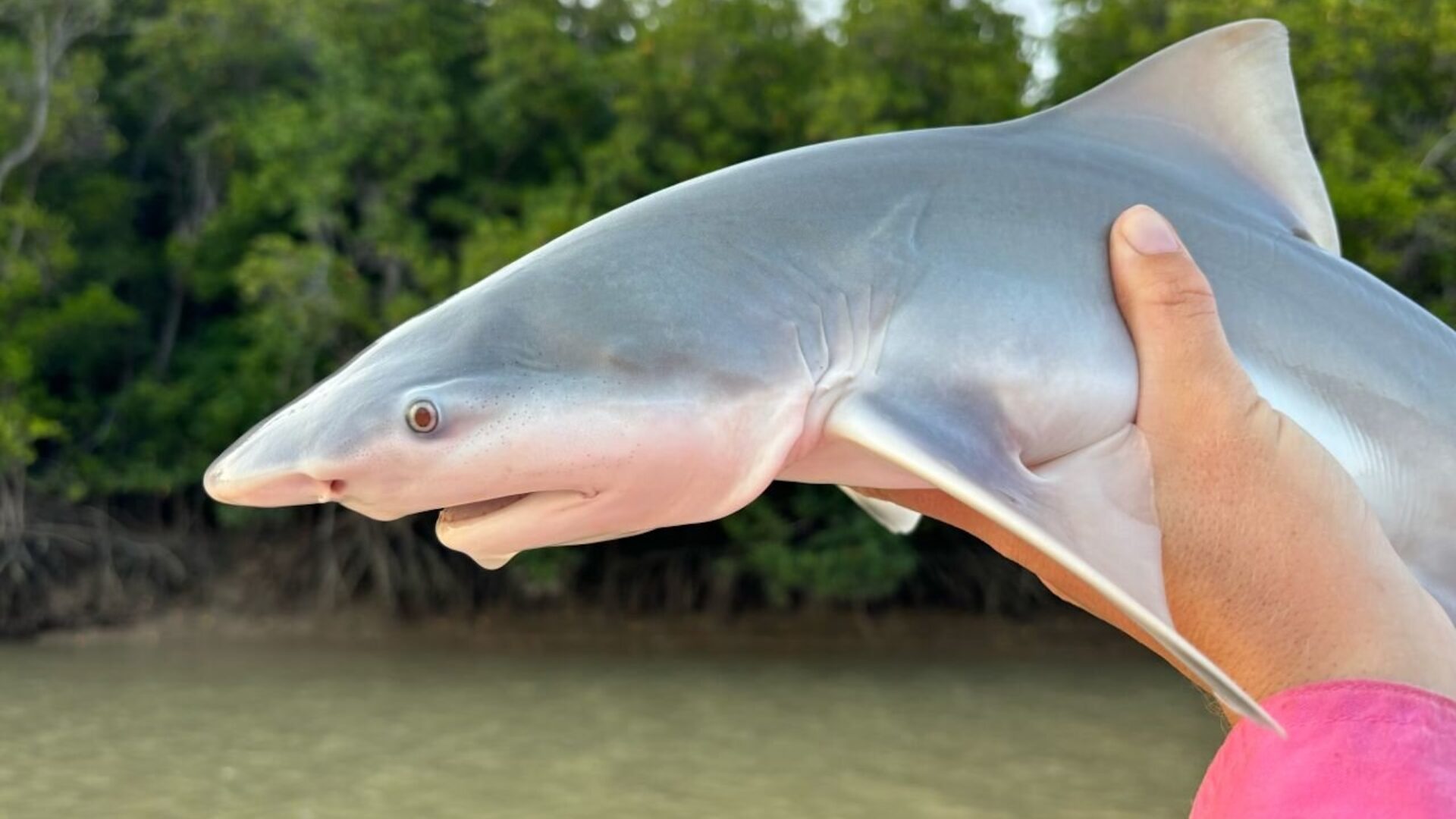
To test their approach, authors including earth scientist Brandon Mahan focused on the vulnerable speartooth shark . With only around 2,500 adults living in the rivers and estuaries of Australia and Papua New Guinea, the roughly 8.5-foot-long speartooth is one of the world’s most vulnerable shark species.
After collecting samples from specimens that died of either natural deaths or from accidental fishing, Mahan’s team used X-ray scanning and what’s known as laser ablation inductively coupled plasma mass spectrometry (LA-MC-ICP-MS). This involves aiming a focused laser beam at a shark vertebrae, which then converts the sample into an aerosol that is then examined by a mass spectrometer. Scientists use similar strategies to assess data at the molecular level in botany, archaeology, geology, and even pollution tracking.
With the method, the team linked geochemical information to the speartooth’s environment. Mahan offered strontium as an example. The element accumulates in the shark’s vertebrae as they grow, but only in amounts that correlate to environmental strontium levels. By comparing these readings with local precipitation records, the researchers could tie shark vertebrae composition and age to the region’s wet and dry seasons.
“So, in addition to providing a way to estimate shark age, our vertebral geochemical fingerprinting also differentiates between the water environments the shark inhabits during its lifetime,” Mahan wrote in his university rundown.
According to their findings, the previous method of vertebrae band counting is far less accurate for age estimation—at least for speartooth sharks. Mahan explained that age is vital to monitor population health, as well as tailoring conservation strategies for various species. With further study and refinement, researchers believe their novel merging of interdisciplinary fields will lead to more effective, precise, and helpful ecological solutions for not only sharks, but many other animals, as well.
The post Shark lasers could help save vulnerable species appeared first on Popular Science.
Shark lasers could help save vulnerable species
previous post
