
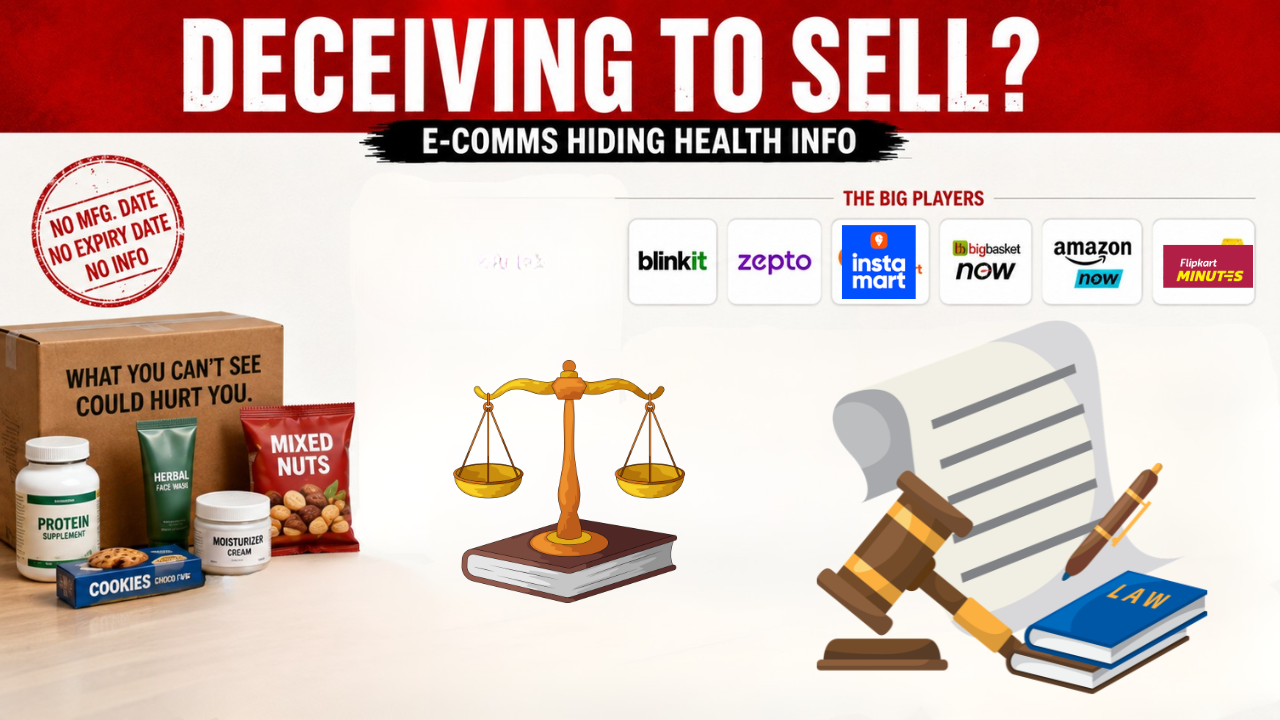
Deceiving to sell: When you pick a product off a shop shelf, you turn it over and check one thing first: when was it made, and when does it die? On India’s quick-commerce apps, that box is simply missing. No manufacturing date. No expiry. Tap, pay, delivered in ten minutes, and you have no idea what you’re actually eating, swallowing or putting on your skin.
Times Now Digital has launched a campaign — “E-Comms Hiding Health Info” — to hold these platforms accountable for burying information you are legally entitled to see.
The pattern is hard to miss. As ten-minute delivery exploded after Covid, the regulatory check at the door seems to have gone ‘quick’ too — quick to approve, quick to skip the basics. Missing manufacturing and expiry dates say exactly that. And the concern is no longer theoretical: cases are piling up across food, cosmetics and health products sold online.
We asked the biggest names in the business – Blinkit, Zepto, Swiggy Instamart, BigBasket, Amazon Now and Flipkart Minutes – a simple question: why are manufacturing and expiry dates not on your listings? Every one of them stayed silent. Blinkit and Amazon asked for 48 hours. We gave them another 48.
Still not a word, as of June 27.
But here’s what the apps won’t tell you: whether you shop in a store or on a screen, your rights don’t shrink. Here’s what the law actually gives you.
Q: Do these platforms even have a legal duty to show this information?
According to legal professionals, Indian consumer protection and product-labelling laws require online marketplaces to display essential product details that help buyers make informed decisions, particularly for food products, cosmetics, health supplements, and other goods carrying shelf-life declarations.
Varun Katiyar, Managing Partner at Consortium Legal, told Times Now Digital: “In the online marketplace, this responsibility becomes even more important because consumers cannot physically inspect products before buying them. Non-disclosure of such information can be viewed as a failure of transparency and may amount to an unfair trade practice or deficiency in service under consumer protection laws.”
Abhishek Bagga, Associate Partner, King Stubb & Kasiva, added: “Under the Legal Metrology (Packaged Commodities) Rules 2011, read with the Consumer Protection (E-Commerce) Rules 2020, consumers are entitled to be provided with all mandatory product information before deciding whether to make a purchase. Where a product is legally required to carry an expiry, best before or use by declaration such as food products, health supplements and several cosmetic products that information must ordinarily be displayed on the online product listing.”
Q: A product arrives expired. What can you actually do about it?
Experts noted that consumers who discover that a product is expired or nearing expiry after delivery can seek refunds, replacements, or other remedies through the seller or platform’s grievance redressal mechanism.
If complaints remain unresolved, consumers can approach Consumer Disputes Redressal Commissions under the Consumer Protection Act, 2019. Remedies may include refunds, compensation for losses or inconvenience, and directions against unfair trade practices.
Bagga added that consumers can also raise complaints through the National Consumer Helpline or the INGRAM portal. Depending on the nature of the product, complaints may be filed with the Central Consumer Protection Authority (CCPA), Legal Metrology authorities, or the Food Safety and Standards Authority of India (FSSAI).
In cases where expired products cause illness, injury, or financial loss, consumers may also pursue product liability claims under the Consumer Protection Act.
Q: Who’s on the hook – the seller, the app, or both?
While the seller and manufacturer bear primary responsibility for ensuring compliance with product safety and labelling requirements, experts said e-commerce platforms cannot completely distance themselves from such violations.
Varun said the extent of liability would depend on the platform’s role — whether it was merely providing a marketplace or had knowledge of violations and failed to take corrective action.
Decoding it further, Abhishek said that under the Legal Metrology (Packaged Commodities) Rules, the e-commerce platform has an independent obligation to display mandatory declarations, including the expiry or best-before date wherever applicable. A failure to comply with that obligation may expose the platform to liability separate from that of the seller.
Q: You’ve complained again and again. They keep ignoring it. Now what?
Persistent failure to disclose mandatory expiry information is not merely a customer service issue — it is a potential violation of consumer protection and product labelling laws. Such non-compliance can expose both the seller and, in appropriate cases, the e-commerce platform to consumer proceedings as well as regulatory action.
Consumers can approach Consumer Commissions alleging deficiency in service and unfair trade practices if repeated complaints are ignored. Authorities such as the CCPA, Legal Metrology departments, and FSSAI may also intervene in cases involving systemic non-compliance, they said.
A date on a label is not a courtesy. It is the law, and it is the difference between a product that’s safe and one that’s quietly past its end. The apps built their business on speed. They don’t get to outrun the basics. Times Now Digital will keep asking until they answer.
