
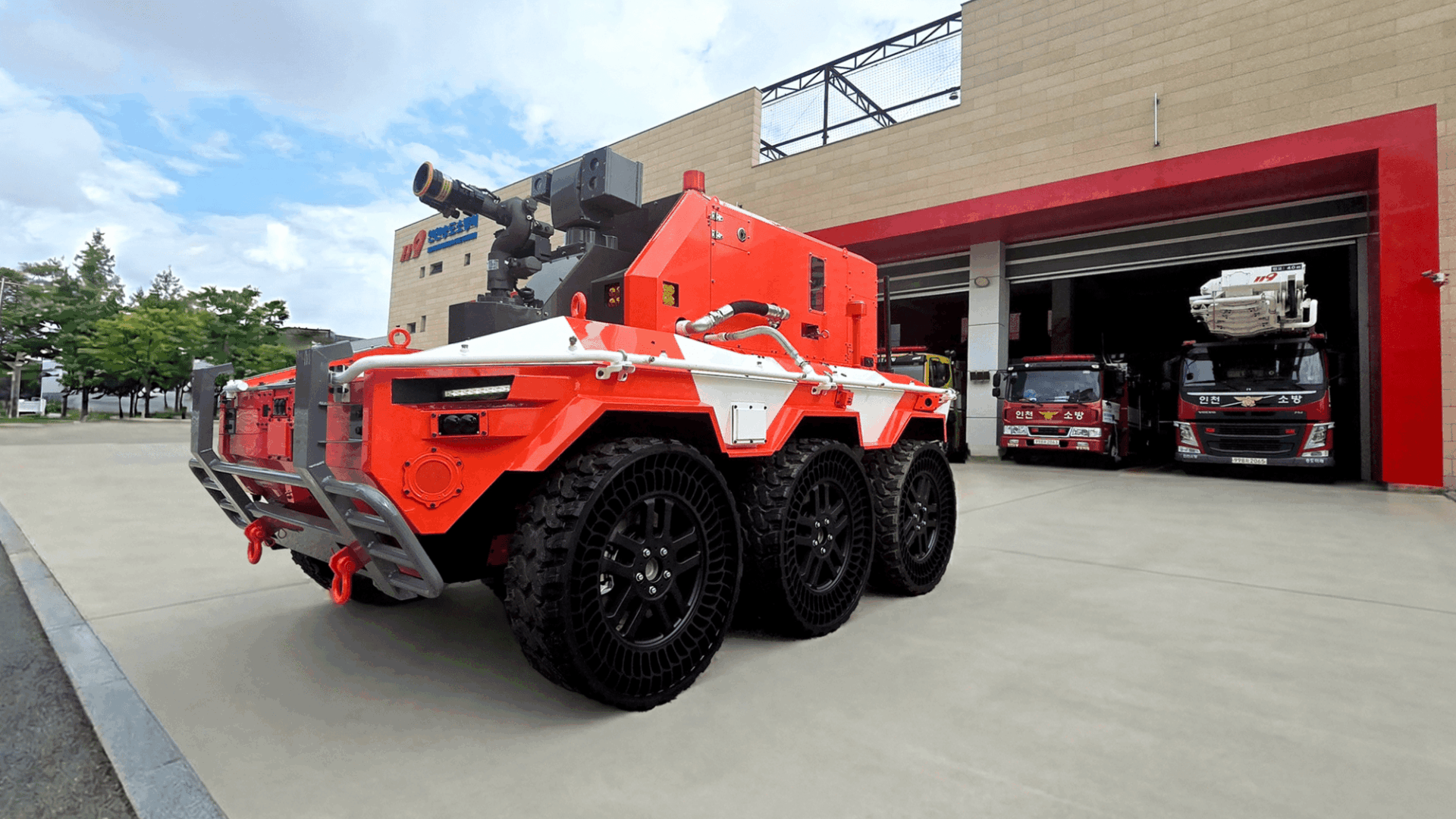
Firefighters in South Korea will soon start deploying alongside a massive, six-wheeled, self-cooling autonomous robot that could help keep them safe. Hyundai recently revealed the new, driverless ground drone, built atop a chassis initially intended for military use and looking like something out of a sci-fi film. The robot has a massive hose—in place of a munitions cannon—that can both douse fires and illuminate dark areas to help in search and rescue situations. It also has thermal imaging sensors that can see through thick smoke. Hyundai says the goal is to send the bright, red behemoth into dangerous areas ahead of firefighters to start tackling blazes and map out safe escape routes.
“By tackling dangerous situations in place of people, the robot ultimately protects the lives and safety of firefighters and citizens,” Hyundai notes in a press release.
Firefighting is a crucial but deadly job. Data from South Korea’s National Fire Agency and cited by Hyundai estimates that 1,788 firefighters were killed or injured on the job over the past decade. In the U.S., the National Fire Protection Association estimates there were 62 firefighter deaths while responding to incidents in 2024 alone. Even when first responders survive, toxic smoke and falling debris can expose them, and those they are trying to save, to serious injury.
That’s where this new Unmanned Firefighting Robot comes in. The machine operates on a self-driving platform, meaning it can enter dangerous areas without any human onboard. It can also maneuver into extremely hot environments that would normally burn a human driver. The firefighting robot uses a self-spraying system that continuously cools it with water, keeping its external temperature between 122 and 140 degrees Fahrenheit even when operating in environments exceeding 1,000 degrees.
Two fire stations are currently testing the firefighting robot. Image: Hyundai Motor Group
The truck (though it’s really more like a tank) can reach speeds of up to 31 miles per hour. More importantly for firefighting, its chassis lets it climb inclines of up to 60 percent, meaning it can reliably access sloped areas like underground parking lots and warehouse ramps. When not spraying water, its hose also acts as a powerful light source to light the way for firefighters entering a building. Each wheel has its own independent motor with waterproof electrical modules to prevent malfunctions in difficult terrain.
AI vision cameras mounted on the robot can see through smoke and plan routes for firefighters. Image: Hyundai Motor Group
“The true value of this robot is not merely its heat resistance or fire suppression power, but its role as a ‘Physical AI’ that operates in actual disaster sites,” National Fire Agency Acting Commissioner Seung-ryong Kim said in a statement. “In extreme environments where firefighters cannot enter, it will collect and learn from real-world operational data to develop into a sophisticated disaster response platform.”
Though it’s unclear how much each of these robots cost, Hyundai says it has already donated two of them to a pair of firefighting stations in South Korea, with two more on the way. And they aren’t alone in the firefighting robot space. The Los Angeles Fire Department began experimenting with their own, lower tech fire fighting drone back in 2020. Boston Dynamics’ Spot quadruped robot (also owned by Hyundai) has also been deployed in some firefighting efforts.
The post Autonomous firefighting robot can drive straight into a 1,000 degree blaze appeared first on Popular Science.
