
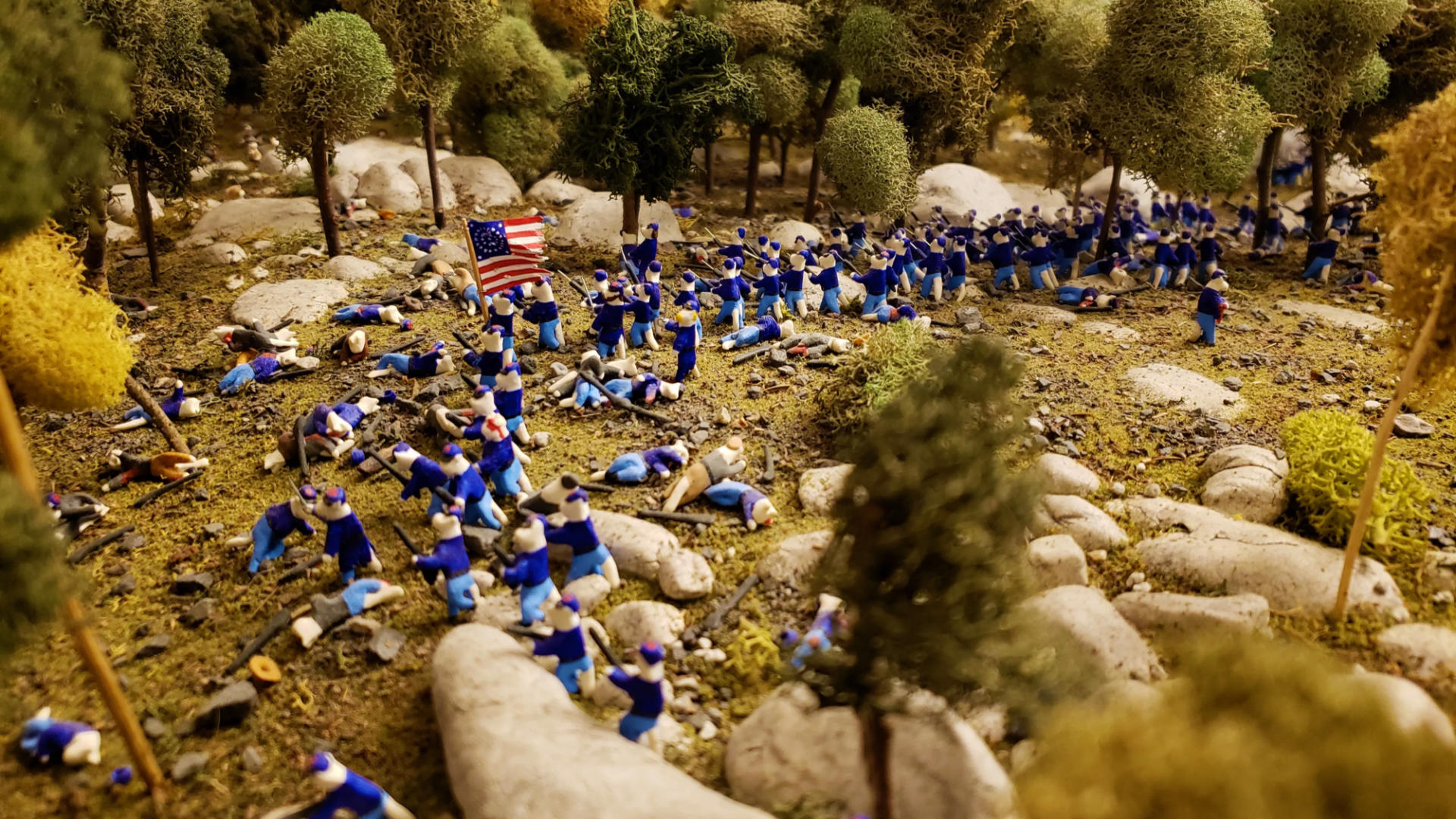
A stone’s throw from the hallowed ground of the Gettysburg Battlefield, where over 51,000 soldiers died over three days, visitors can learn about the American Civil War with a medium most associated with elementary school projects. But these aren’t your second grade teacher’s dioramas.
At the Civil War Tails at the Homestead Diorama Museum, thousands of handmade clay cats depict some of the war’s hallmark moments–from Fort Sumter to Pickett’s Charge to lesser known naval battles.
“We’ve been making our cats for 31 years now,” Rebecca Brown, the museum’s curator and diorama maker, tells Popular Science. “My twin sister Ruth and I always had cats as pets, but when we were 11, I read biographies of Generals Lee and Grant. I then made them out of clay, and they just automatically came out as cats in uniform.”
“The Fate of Gettysburg” depicts fighting at the Angle during Pickett’s Charge at Gettysburg on July 3, 1863. Image: Rebecca Brown/Civil War Tails at the Homestead Diorama Museum.
These handmade miniature soldiers offer visitors a three-dimensional way to learn about the Civil War. The dioramas are all made with a one-to-one ratio. This means that each model cat soldier represents one soldier during the real battle, not 10 or 50. All of the dioramas are also all made to scale. If a hill looks like it would have been a monster to climb while dodging cannon fire and bullets, it was.
The cats don Union and Confederate soldier uniforms, and some boast highly detailed corps badges.
“The corps badges are a different shape depending on the corps. They were kind of like a morale booster that [General] Joseph Hooker introduced. So each division within a corps has a badge,” Brown explains.
Colonel Strong Vincent’s Brigade (Third Brigade, First Division, Fifth Corps) had a red cross corps badge. Image: Rebecca Brown/Civil War Tails at the Homestead Diorama Museum.
As with many buildings in Gettysburg, the museum itself is also a piece of Civil War history. It once belonged to the National Soldiers’ Orphans’ Homestead, a home for orphans after the war. The museum occupies the area formerly used as the girls’ dormitory.
Bringing battles to life
Rebecca and Ruth began working on these dioramas in earnest in 2011. As the country approached the 150th anniversary of the Civil War, they decided to try to create one diorama per year corresponding with a battle, beginning with 1861’s Fort Sumter. The Confederate victory in Charleston, South Carolina, was the spark that ignited the Civil War.
The Fort Sumter diorama was made in 2011. Image: Rebecca Brown/Civil War Tails at the Homestead Diorama Museum.
For 2012, Brown focused on a lesser-known Virginia naval battle. The Battle of Hampton Roads was fought on March 8 and 9, 1862, and marked the first-ever combat between two ironclad warships. The clash pitted the Union’s USS Monitor against the Confederate ironclad CSS Virginia. Notably, the Virginia was made from the hull of the USS Merrimack. The Union navy had scuttled the Merrimack in 1861 to prevent the Confederacy from using it, but the Confederacy still managed to salvage it.
The CSS Virginia launched a devastating surprise attack, sinking the wooden USS Cumberland, forcing the USS Congress to surrender and burn. The USS Minnesota also ran aground. In total, 261 Union soldiers died with 108 wounded in its battle with the Virginia.
The USS Monitor fought in the first battle between two ironclad warships in U.S. history. Image: Rebecca Brown/Civil War Tails at the Homestead Diorama Museum.
“Even if you do know the Monitor and Merrimack and how the battle was basically a draw between the two, the previous day [March 8] has been called the worst defeat for our navy until Pearl Harbor.”
Brown has been working on a diorama featuring the Cumberland for about two years. It has 200 cats, most of which are stationed on the gun deck. She is also working on a lift system so that the model of the vessel can open and close. This way, the violent battle scene can have a G-rated version so that younger visitors don’t have to see so much cat carnage.
This particularly challenging project has helped Brown keep her full-time diorama job in perspective.
“You’re not going to get inspired if it becomes work,” she says. “So Cumberland is a nice way to keep it as a hobby because I like tall ships and making tall ships. “It’s funny because I’m so focused on Cumberland, and every now and then I remember I need to make Virginia too.”
Sketching out the USS Cumberland diorama. Image: Rebecca Brown/Civil War Tails at the Homestead Diorama Museum.
Creating a little world
When Rebecca and Ruth started making dioramas as kids, they simply used whatever they could find lying around their house in the Philadelphia area, and ventured to craft stores once they could drive. They now use modeling and sculpting clay to make everything on the cats, including their clothes. They also use lots of cardboard, twigs, fake moss, toothpicks, and various gels that look like water.
And the creations take years to complete. The diorama featuring the 54th Massachusetts Regiment technically began in the late 1990s. Pickett’s Charge took five years to complete while Ruth was in college and after she graduated, while Little Round Top and its 3,000 cats took 11 years.
A clay cat representing Lt. George Morris, in command of USS Cumberland. He is also Cat #10,000. Image: Rebecca Brown/Civil War Tails at the Homestead Diorama Museum.
For those wanting to start making historical dioramas for themselves (but don’t necessarily want them to take years), Brown suggests taking an outward approach. Start with a center point and see how it grows, and try to make it modular so that it can be easily moved and stored away.
“Overall, dioramas are just a really cool way for us to encapsulate a story that we’re reading about,” she says. “I think it’s the pack rat in me, and wanting to keep the story that I’ve read alive, but they’re also their own little world.”
In The Workshop, Popular Science highlights the ingenious, delightful, and often surprising projects people build in their spare time. If you or someone you know is working on a hobbyist project that fits the bill, we’d love to hear about it—fill out this form to tell us more.
The post 10,033 tiny clay cats reenact the Civil War at a Gettysburg museum appeared first on Popular Science.
