
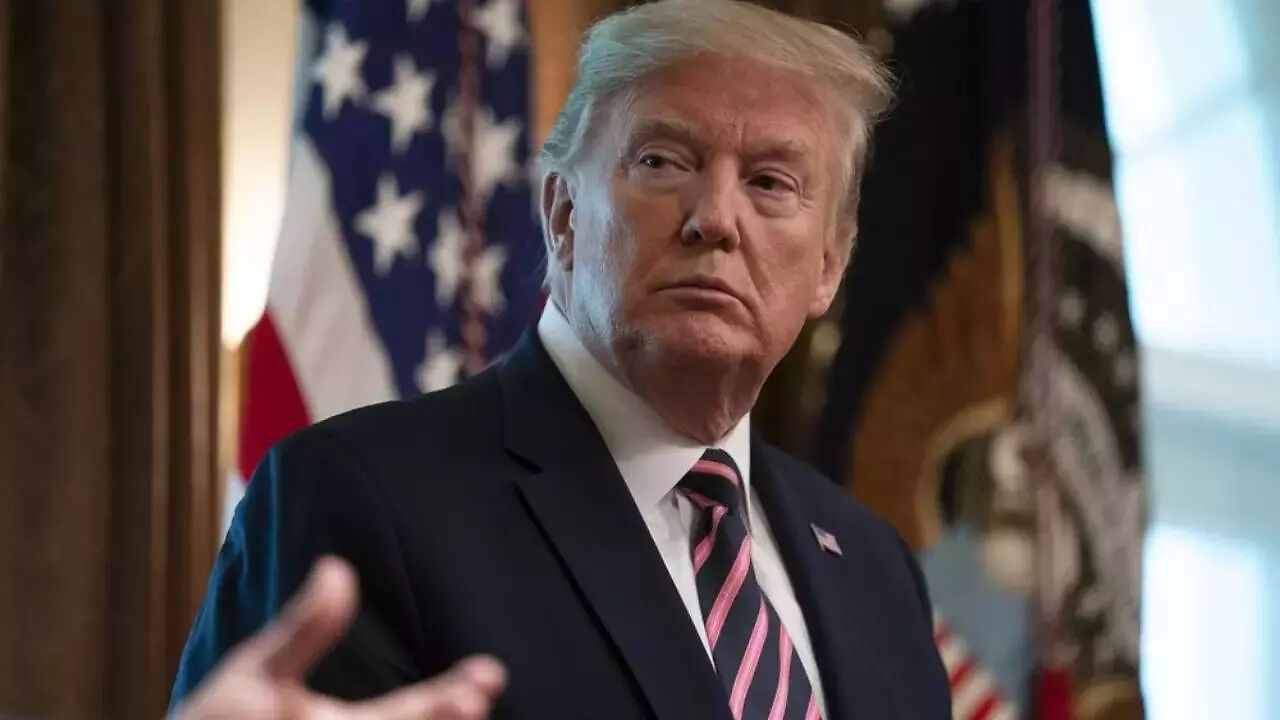
US President Donald Trump has stepped up scrutiny of the H-1B visa programme, directing federal agencies to examine whether sponsoring employers have recently laid off American workers or are planning job cuts that could affect similarly placed US employees. The executive order, signed on September 18, 2026, calls for closer coordination between the Departments of State, Labour, Homeland Security, Commerce and Education, along with the Small Business Administration. The move is aimed at giving agencies access to additional employment, wage, industry and other economic information while assessing H-1B applications.
Under the order, agencies must consider recent or planned layoffs involving similarly situated US workers when assessing H-1B-related labour condition applications, petitions, visas and entries.
H-1B Employers With Layoffs Face Additional Scrutiny
The order specifically directs the Secretaries of State, Labour and Homeland Security to consider whether an employer sponsoring H-1B workers has directly or indirectly carried out layoffs during the preceding year.
Future workforce reductions could also come under the lens if agencies determine that they may negatively affect similarly situated American employees.
“We know that we meet today in the backdrop of ongoing global difficulties. Under these circumstances, and because of the scale of transformation we envisage towards ourselves to reach our shared goal, it needs to be borne in mind that this scale cannot be met solely by government budgets, and that private sector financing will need to play a critical role,” Thakur said.
The order also requires the Labour Department’s Wage and Hour Division to start reviewing information linked to previously filed labour condition applications within 30 days. The review will examine whether additional action against sponsoring employers may be warranted.
Why The Trump Administration Is Tightening H-1B Checks
The White House has argued that parts of the H-1B system have been misused by certain employers, third-party placement groups and outsourcing companies.
According to the administration, some businesses have used H-1B workers in situations where American employees were displaced. The White House order cites technology-sector layoffs and says employers in the sector collectively sought hundreds of thousands of H-1B workers while also laying off between 800,000 and 1.3 million American employees between 2022 and 2026. It further alleges that some US employees were required to train foreign workers who replaced them. These figures and allegations are presented by the White House as the administration’s justification for the policy.
The administration has also raised concerns over outsourcing models in which H-1B workers replace employees at third-party client companies, with some work subsequently moved offshore.
The order identifies other alleged compliance issues, including inaccurate descriptions of job duties or working conditions, positions being incorrectly classified as specialty occupations and questionable educational credentials being used to support applications.
What The New H-1B Order Changes
The executive order does not create an outright prohibition on H-1B hiring by companies that have undertaken layoffs. Instead, it instructs federal agencies to factor recent and planned layoffs into their assessment of H-1B applications and related immigration processes.
It also widens information-sharing between government departments. Commerce, Education and the Small Business Administration are directed to provide relevant data covering areas such as wages, employment, academic information, industry conditions and other economic indicators to agencies administering the H-1B programme.
The stated objective is to improve the government’s ability to identify cases where H-1B hiring may conflict with existing statutory requirements.
$100,000 H-1B Fee Extended For Another Year
The latest order comes alongside a separate presidential proclamation concerning H-1B workers. Trump has extended for another 12 months the restriction requiring a $100,000 payment for certain H-1B petitions involving workers outside the US, subject to specified exceptions.
The renewed restriction is scheduled to take effect at 12:01 a.m. Eastern time on September 21, 2026, and is set to remain in place until September 21, 2027, unless extended again.
The White House said the earlier measure led to a significant reduction in H-1B registrations from large IT outsourcing firms. According to its fact sheet, registrations from the largest IT outsourcing companies fell by 92 per cent after the 2025 proclamation took effect.
