
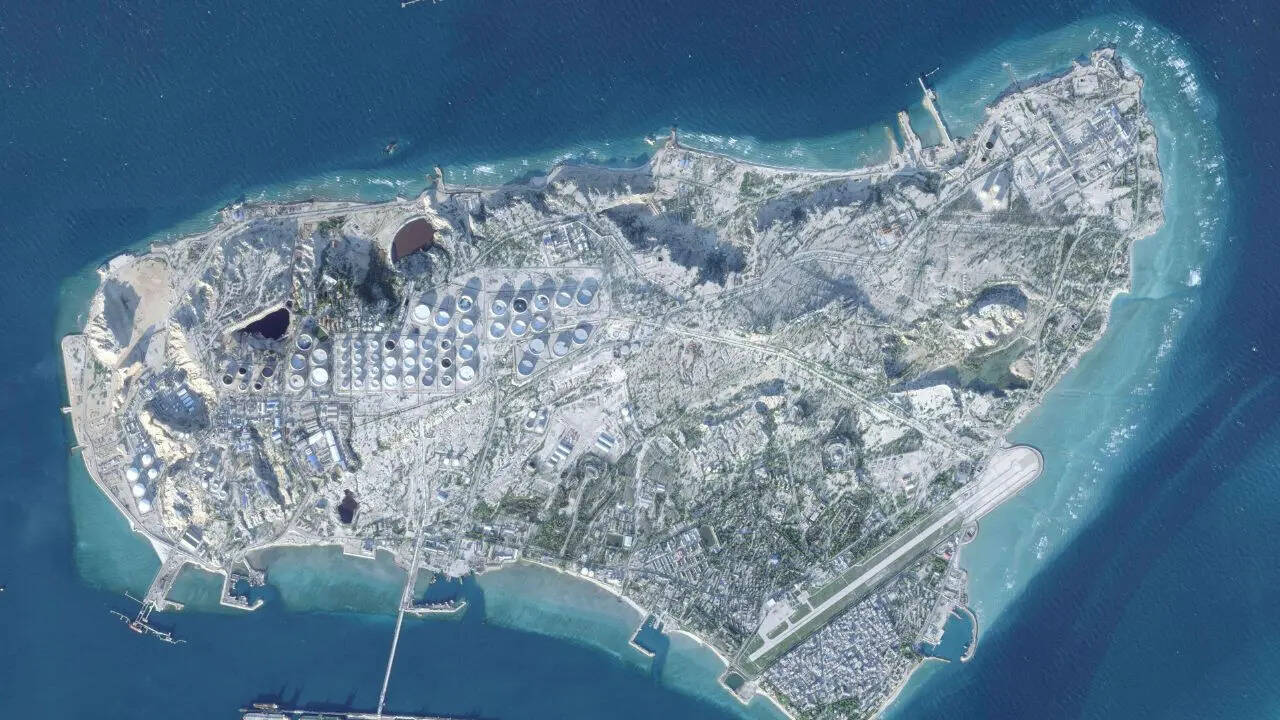
A small rocky island in the Persian Gulf has suddenly emerged as a critical flashpoint in the escalating confrontation between the United States and Iran. Located roughly 15 nautical miles (about 24 km) off Iran’s southern coast, Kharg Island may be modest in size, but it plays an outsized role in the country’s energy system and economic survival.
Iran’s Oil Export Hub
Despite its small footprint, Kharg Island functions as the central hub of Iran’s crude oil exports. An extensive terminal on the island handles the vast majority of the country’s overseas oil shipments.
Crude extracted from fields across Iran is transported through pipelines to Kharg Island, where it is stored and then loaded onto large tankers. These vessels depart from the island’s deep-water jetties and travel south through the Persian Gulf, eventually passing through the crucial Strait of Hormuz before heading mainly toward Asian markets.
China is widely regarded as one of the largest buyers of Iranian crude, making the route particularly important for Tehran’s export revenue.
Because such a large share of the country’s oil exports flows through this single location, analysts often describe Kharg Island as the economic lifeline of Iran.
Financial Artery for Iran’s Power Structure
Revenue generated from oil exports passing through the island is also believed to support key state institutions, including the Islamic Revolutionary Guard Corps.
This makes Kharg Island not just an energy hub but also a strategic financial artery that underpins Iran’s military and political power.
Why Trump Targeted the Island
According to Donald Trump, US forces struck military installations located on Kharg Island, including missile storage facilities, naval mine depots and other defence-related infrastructure.
The operation was carried out by United States Central Command, which said dozens of military targets were hit while deliberately avoiding the island’s oil export facilities.
From a strategic perspective, targeting military assets on the island sends a strong signal without immediately crippling Iran’s economy. Analysts often compare such a move to aiming at the country’s “economic jugular” — demonstrating the capability to disrupt oil exports if tensions escalate further.
Trump has also warned that the decision not to strike the oil terminal could change if Iran interferes with shipping through the Strait of Hormuz, one of the world’s most critical energy corridors.
Why the Oil Terminal Was Spared
Directly attacking Kharg Island’s oil infrastructure would represent a major escalation in the conflict.
Such a strike could significantly reduce Iran’s oil revenue, but it would also risk sending global energy prices sharply higher and triggering retaliation across the Middle East.
Iran has already warned that any attack on its energy infrastructure could prompt strikes against oil facilities or shipping linked to US allies. Tehran also maintains the capability to launch large-scale drone and missile attacks on regional energy infrastructure.
A Strategic Pressure Point
By targeting military installations while sparing the oil terminal, Washington appears to be signalling both restraint and leverage.
Kharg Island’s central role in Iran’s oil export network makes it one of the most sensitive pressure points in the conflict. If the island’s energy infrastructure were ever directly targeted, the economic and geopolitical consequences could ripple far beyond the Middle East.
