
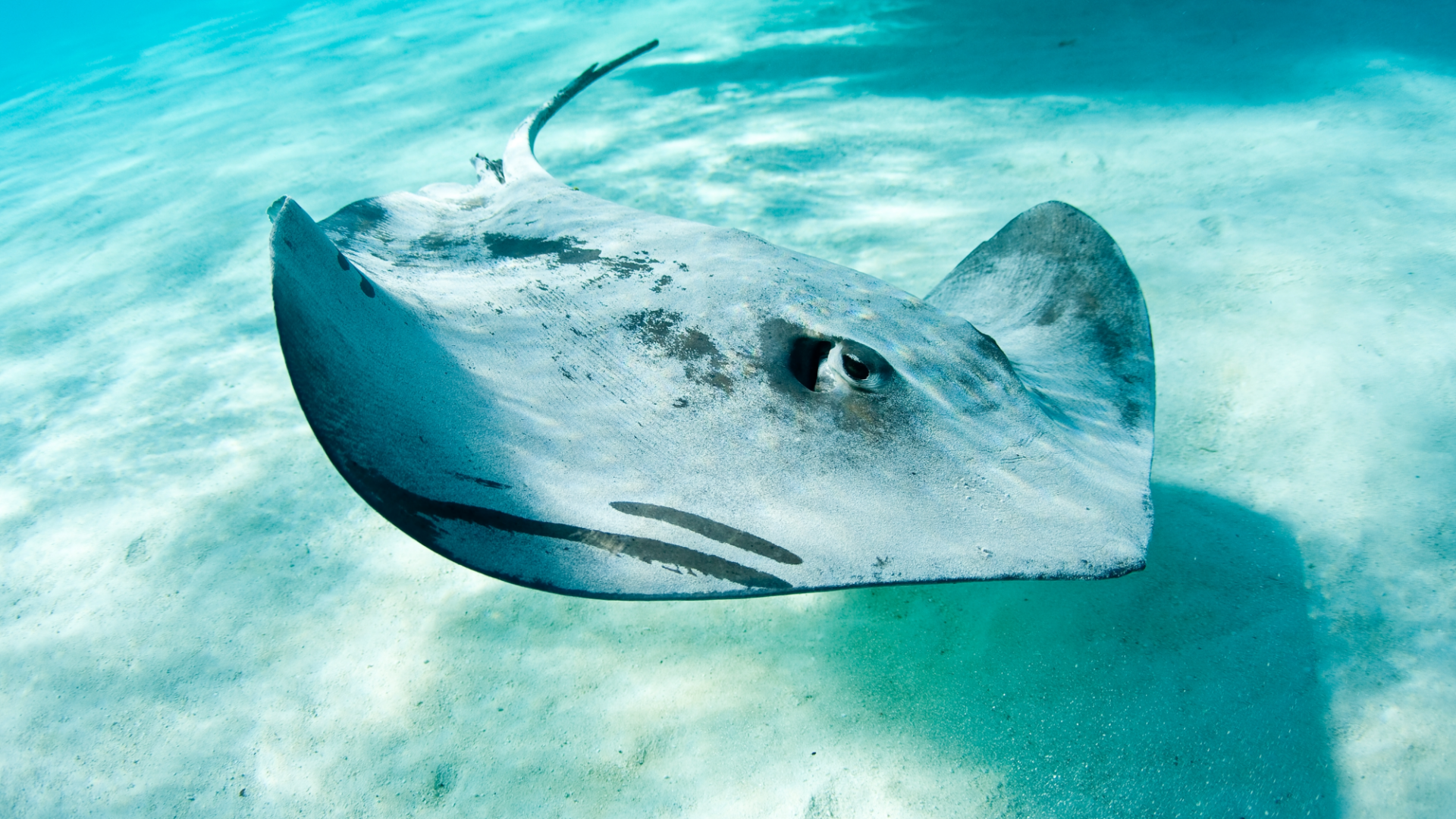
To help figure out what makes stingrays such unique and unusual swimmers, a team of mechanical engineers at the University of California, Riverside (UCR) created a wavy robotic fin. After submerging the robot in underwater tunnels designed to mimic swimming near the sea floor, their tests indicate that different types of ray species may have evolved alternative swimming techniques that best suit their setting. Specifically, the findings suggest that some ray species swimming near the seafloor adjust the way their fins move and tilt to counter a downward force that would otherwise pull them toward the ground.
It turns out that stingrays gracefully gliding along waves near seabeds aren’t doing it to look cool. Instead, the fancy flapping is likely an evolutionary adaptation for stability and durability while swimming. The team behind the mechanical fin believes those same principles could one day be applied to designing energy-efficient underwater mapping robots. And they aren’t alone in admiration for rays. Other researchers are already attempting to use insights from stingray swimming to develop stealthier next-generation underwater vehicles.
The robotic fin study was published this week in the Journal of the Royal Society Interface.
Putting stingray swimming to the test
When it comes to swimming, not all ray species are alike. Massive manta rays and other pelagic ray species tend to hover near the ocean surface using a flapping motion. Benthic rays, like stingrays who spend their time in more shallow waters, rely on a different undulating movement which often resembles the motion of the very waves they’re swimming in. This second wavy swimming style in particular has fascinated scientists for its apparent simplicity and efficiency. Past research on that swimming method has shown that the undulating motion used by stingrays actually appears to recycle energy from surrounding water more efficiently than brute-force fin flapping.
Varying styles of stingray fin movements. Image: Yuanhang Zhu/UCR.
UCR mechanical engineer and paper co-author Yuanhang Zhu had a hunch that the divergence in swimming styles might stem from the different environments ray species inhabit. To test that theory in controlled environments, the team set out to create the robotic fin. By testing the fin under different conditions, the researchers could observe how physical forces in the water affected its movement. The final fin design measured only 9.5 millimeters (about 0.4 inches) thick and was molded from silicone rubber. They also constructed a large water tunnel designed to simulate ocean flow.
During their experiments, the team placed the robot both near the surface of the tunnel and lower, closer to the artificial sea floor. In both cases, they were looking to see how various levels of ocean flow impact the amount of lift imparted on the fins. Understanding lift is important because it plays a key role in determining whether or not objects moving through space can stay level. For example, birds flying close to the ground experience positive lift keeping them more level and steady. The researchers expected to see something similar occur for the robotic ray swimming near the sea floor. Instead, the exact opposite happened. Their robot was being sucked downwards.
“This wasn’t what we expected,” Zhu said in a UCR blog post. “Instead of gaining extra lift near the ground, the rays were pulled downward.
Surprised by the findings, the team made slight adjustments to the robot to try compensate for the negative lift. They found that the downward force could be reduced simply by tilting the robot fin upward by a few degrees. Extrapolating out from that, the researchers suggest that stingrays and other benthic rays naturally swim with a slight upward fin angle, something that wasn’t clear before. During testing with, the stingray-like undulating motion also consistently maintained better clearance from the seafloor than the flapping motion used by pelagic ray species.
“Nature seems to have already solved the problem,” Zhu added.
Robots and underwater vehicles of the future
This isn’t the first time engineers have tried to apply a ray’s unique biology to the world of robotics. In 2018, engineers from UCLA designed a 10 millimeter long tissue-based stingray-style robot made up of a mix of heart cells and flexible electrodes. Researchers from Harvard made an arguably even stranger stingray biohybrid robot in 2017, powered by rat muscles and propelled forward by a propulsion system triggered by light.
Elsewhere, researchers at the University of Washington are already exploring ways to apply stingray swimming techniques to next generation underwater vehicles. Ultimately, they hope to adapt rays’ structural characteristics to create vehicles that are both more energy-efficient and quieter than current submarines and submersibles.
When it comes to designing mechanisms of the future, the natural world remains undefeated.
The post Stingray-inspired robot cracks the mystery of how rays swim appeared first on Popular Science.
