
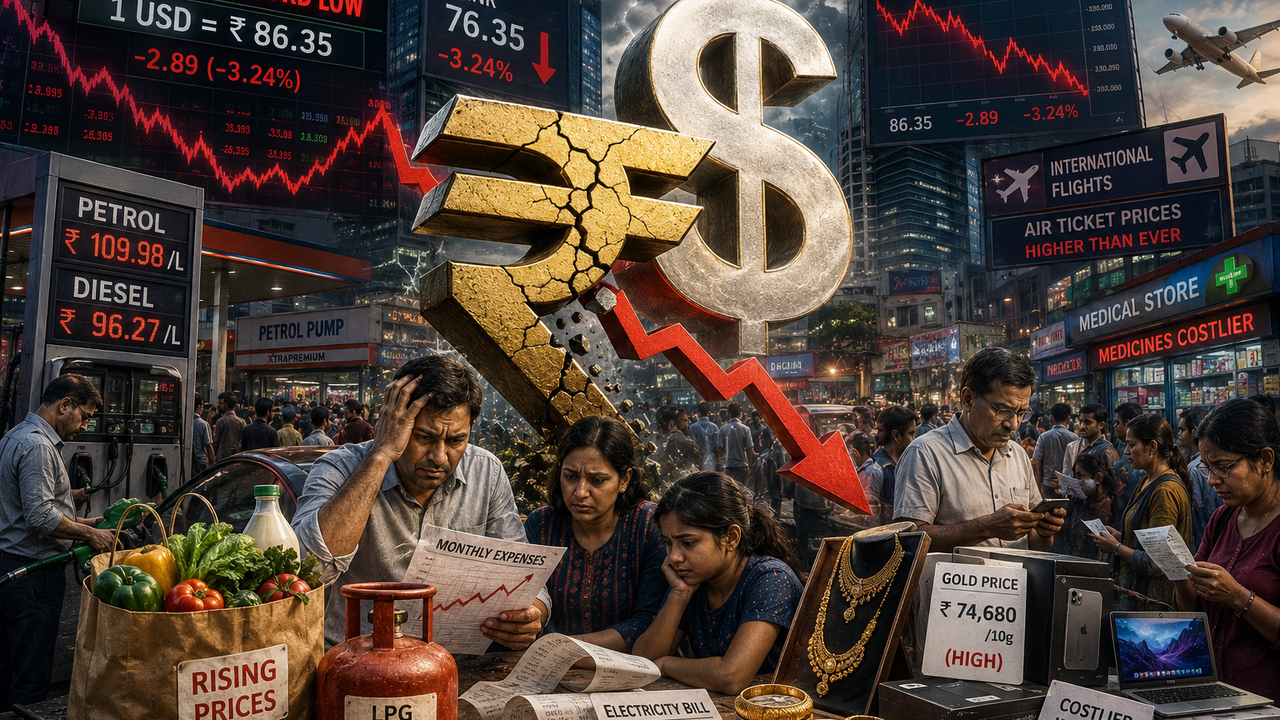
The Indian Rupee for the first time slipped past the 96-mark and to hit a fresh all-time low of 96.14 against the US dollar in intraday trade on Friday. The continuous uptick in Indian Rupee against the US Dollar might look like a distant development happening in the macro economy, but it has a large impact on the day-to-day life of the citizens.
The continuous weakening of the rupee has been dramatically impacted by the rising crude oil prices due to the Middle East crisis, and continuous foreign capital outflows.
Also Read: Rupee vs Gold: Assessing the Real Picture Behind India’s Economic Concerns
How falling Rupee affects your daily life
Rise in fuel prices:
India remains largely dependent on imports to meet about 88% of its total oil requirement. Crude oil purchases are made in the US dollars, and the oil marketing companies end up paying more in rupee terms when the Indian currency weakens.
This is evident from the recent move by the government to hike the prices of petrol and diesel by Rs 3 per litre.
Rise in prices of vegetables, food items:
Higher fuel costs also increase transportation expenses. This, in turn, is likely to make vegetables, food items and other essentials expensive as these items are sent across the locations through transportation.
Elevated gold prices:
India heavily depends on imports for meeting its gold demands. Again, the import bills are paid in US Dollar, leaving dent of foreign exchange. As more forex is diluted, Rupee falls.
Policymakers try to stabilize the rupee, and discourage non-essential imports of gold, turning to high prices of gold.
Inflation concerns mounts:
A weak rupee is often termed as “imported inflation” by the economists as it raises the cost of imported goods and raw materials.
The higher costs faced by the businesses are often passed to the consumers in form of high prices of the commodities. This in turn, increases the chances of higher inflation and reduce household purchasing power over time.
Why Indian Rupee continues to decline?
India’s foreign exchange markets have experienced heightened volatility amid the ongoing West Asia crisis. It is driven largely by rising energy prices and moderating capital flows as the Reserve Bank of India (RBI) has responded proactively, taking measures
to curb speculative activity and ensure orderly movements in the exchange rate.
In the last one year, the Indian Rupee has declined 11%, out of which 4.7% occurred since the Iran war started.
India’s dependence on imports:
India remains largely dependent on imports to meet about 88% of its total oil requirement and 51% of its gas requirement.
West Asia accounts for 15% of India’s goods exports, and nearly 38% of India’s total inward remittances come from this region.
CareEdge Ratings expected India’s Current Account Deficit (CAD) to widen to 2.1% of GDP in the Financial Year 2027, assuming global crude oil prices average at USD 90/bbl.
The CAD still remains comfortable compared to some of the previous stress periods. Robust growth in services exports has been a supporting factor for India’s current account balance in the last few years, it said.
Foreign investors continue to exit:
Further, India’s Foreign Portfolio Investors (FPIs) outflows intensified after the West Asia conflict, reaching USD 13.6 billion in March, the highest monthly outflow in the last six years. FPI outflows for FY26 were recorded at USD 16.6 billion, as against inflows of USD 2.7 billion in FY25.
The Foreign Direct Investment (FDI) outflows have also been weighing on India’s net FDI inflows as in the 11 months of FY26, India’s net FDI inflows were modest at USD 6.3 billion following a poor USD 1 billion in FY25.
