
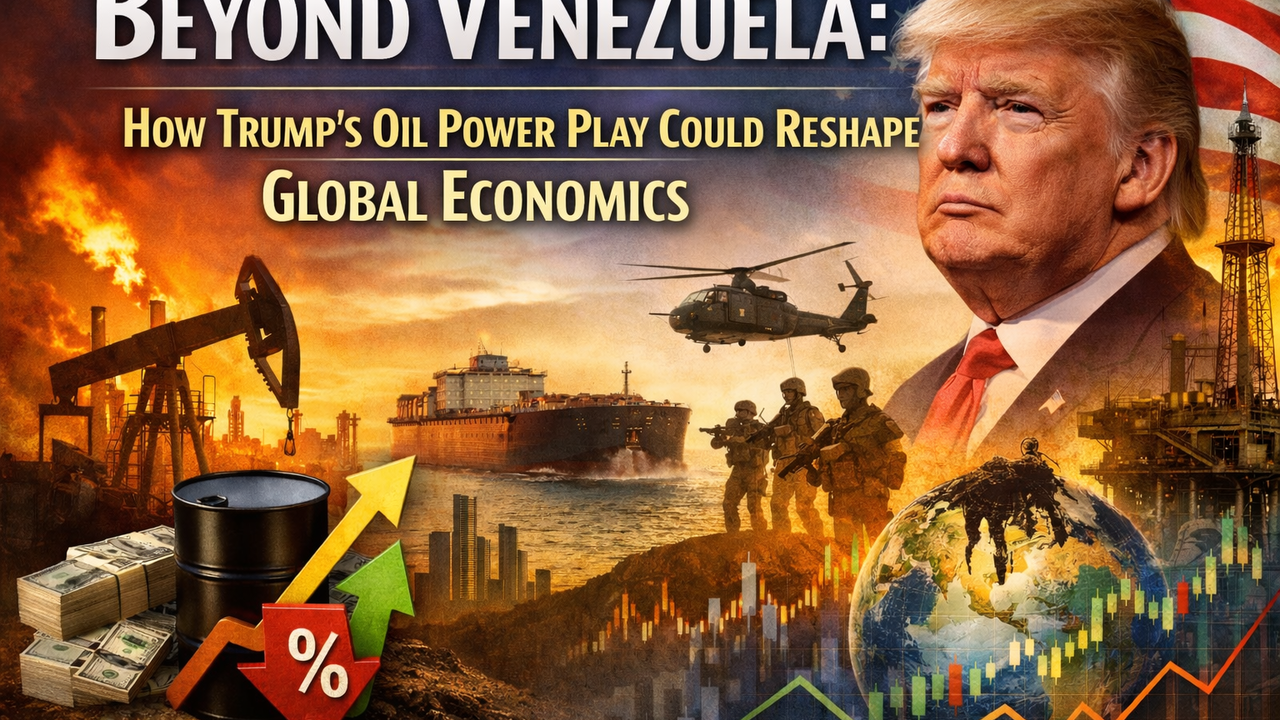
A new geopolitical storm is brewing as the United States takes control of Venezuela’s oil reserves. The move marks a dramatic shift in global energy politics, alters oil market dynamics, and injects fresh uncertainty into financial markets. China and Russia are closely watching developments. While oil prices may rise in the short term due to uncertainty, the longer-term outlook points to potential price declines. Emerging markets could benefit from lower inflation and interest rates if that scenario plays out.
On January 3, the United States carried out military strikes in Venezuela, with US special forces capturing President Nicolás Maduro and extraditing him to face narco-terrorism charges. US President Donald Trump has since announced that Washington will oversee Venezuela’s political transition, take control of its vast oil reserves, and encourage American companies to revive the country’s struggling oil industry.
The move represents one of the most significant geopolitical shifts in Latin America in decades and comes at a time when global markets are already grappling with heightened volatility. For investors, the key question is whether this development will trigger sustained disruption—or ultimately stabilise energy prices.
Venezuela’s Oil: Why It Matters
Venezuela sits on the largest proven oil reserves in the world. Estimates suggest the country holds around 303 billion barrels of crude—nearly a fifth of global reserves. With this takeover, the US effectively gains direct influence over a massive portion of global oil supply, extending its energy footprint across the Americas.
Analysts note that nearly 30% of the world’s total oil reserves now fall under US influence, strengthening Washington’s position as a global price-setter rather than a price-taker. This represents a notable shift in global energy dynamics.
Another advantage for the US lies in refinery compatibility. Most American refineries are designed to process the heavy-grade crude produced in Venezuela, making integration of Venezuelan supply technically feasible.
A Crippled Industry, Not an Instant Windfall
Despite its vast reserves, Venezuela’s oil industry is in poor shape. Once the world’s largest oil exporter, the country has seen production collapse over the past few decades. From a peak of 3.7 million barrels per day in the 1970s, output has fallen to less than 1 million barrels per day today—just 0.8% of global production.
Years of under-investment, mismanagement, political interference, corruption, and international sanctions have left the sector severely degraded. Infrastructure is ageing, expertise has drained away, and operational capacity remains limited.
Market strategists caution that US intervention alone will not unlock Venezuela’s oil potential overnight. Even with political stability, the poor state of extraction and transportation infrastructure, combined with the challenges of refining heavy crude, means output increases will take time.
Oil Prices: Short-Term Spike, Medium-Term Pressure
In the near term, oil prices could rise as markets price in geopolitical risk and uncertainty. Any adverse response from China or Russia could add to volatility and lift the risk premium embedded in crude prices.
However, the medium-term outlook appears more bearish. If US companies re-enter Venezuela and investment resumes, production could increase by 500,000 to 1 million barrels per day within two years. Such a supply boost would add downward pressure on global oil prices, especially if demand growth remains modest.
This potential supply expansion is why some analysts see the current disruption as a temporary shock rather than a structural inflation driver.
Implications for Inflation, Rates and Emerging Markets
If oil prices soften over time, the impact could be significant for global macro trends. Lower energy costs would ease inflationary pressures, giving central banks more room to cut interest rates. This would be particularly beneficial for emerging markets, which are more sensitive to energy prices and global financial conditions.
Cheaper oil could improve current account balances, stabilise currencies, and support equity and bond markets across oil-importing nations. In that sense, Trump’s aggressive oil strategy—while destabilising in the short run—could ultimately prove supportive for emerging market returns.
The US takeover of Venezuela’s oil assets marks a watershed moment in global energy geopolitics. While the immediate aftermath is likely to be volatile, the longer-term consequences may reshape oil prices, inflation trajectories, and investment flows in ways that markets are only beginning to price in.
