
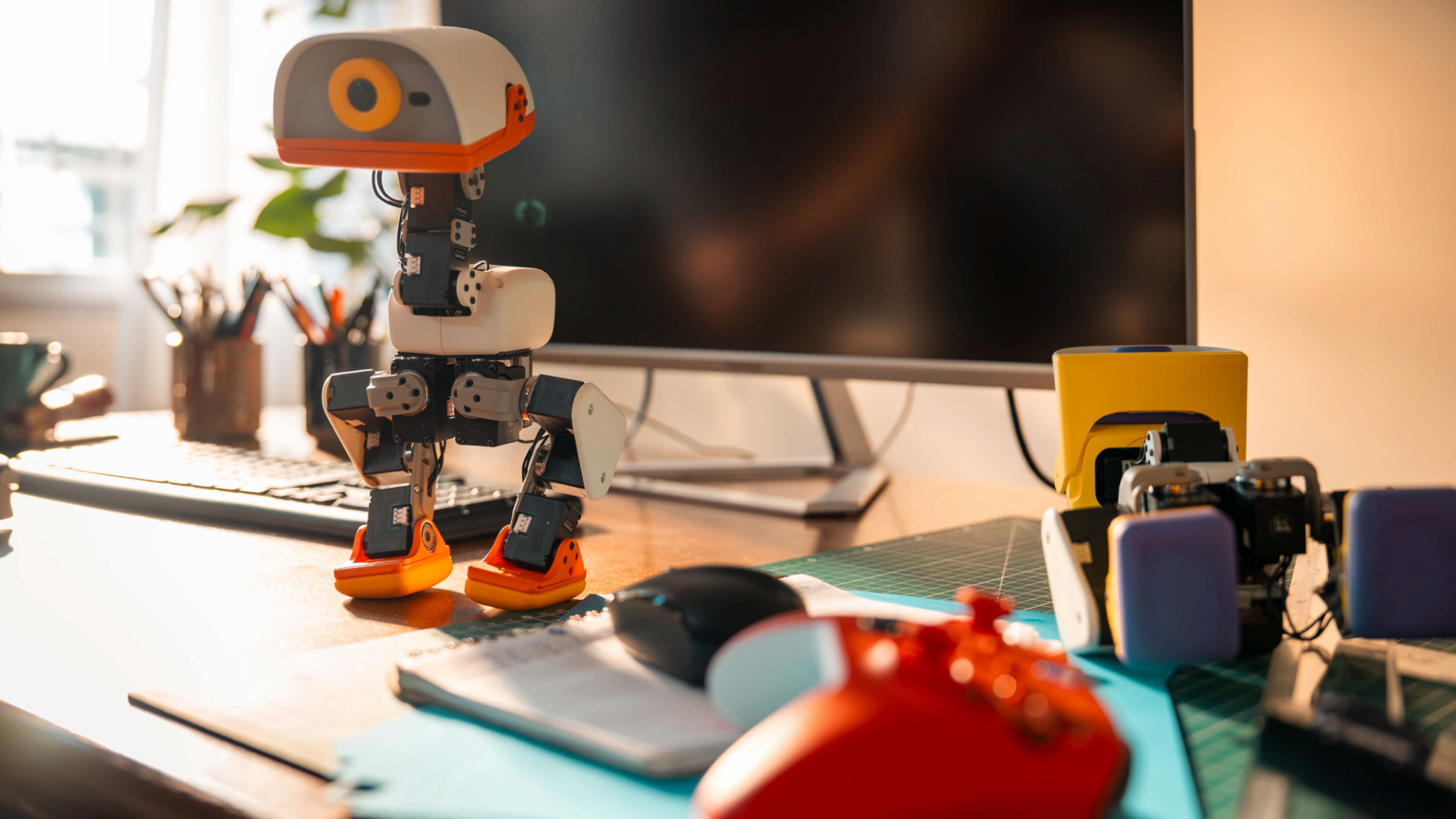
Sorry, cats and dogs, there’s another goofy pet vying for your owner’s attention, and this one doesn’t have fur or stink up the apartment. In fact, this companion is not even alive. It’s a lampshade-sized, armless, bipedal robot named Microduck. And while other robot pets have come and gone, AI data science company Hugging Face says that their Microduck is capable of learning new tricks.
“It’s a tiny $399 open-source robot you can teach new tricks with reinforcement learning,” Hugging Face cofounder and CEO Clément Delangue said in an X post Thursday. “It can walk, pick things up, get back up when it falls, and even roller-skate.”
A pet robot designed to fall down
Microduck stands 10 inches tall (about as tall as a terrier) and weighs just 1.7 pounds (roughly the same as a chicken). It’s equipped with a camera to see and a microphone to hear, as well as tiny LiDAR sensors (like the ones spinning atop driverless cars) to keep it from bumping into things. It features an articulated “beak,” which the company says works like a gripper to grab small objects like loose socks. It can waddle on two legs or use a roller-skate attachment for extra speed.
Onboard sensors help it maintain balance and recover from falls. Videos show it standing back up after lying flat on its back. The whole robot bears a striking resemblance in appearance and mannerisms to the sprightly BD-1 droid from the recent “Star Wars Jedi” video games.
The quirky robot is a notable departure from the more unsettling machines that typically make headlines today. Companies are investing heavily in humanoid automatons aimed at working in factories and homes. One of those humanoids made in China recently broke Olympic sprinter Usain Bolt’s 100-meter sprint record. Elsewhere, increasingly popular quadrupedal robot dogs deployed by the military and police have exhibited uncanny qualities that would make a Black Mirror writer shudder. Microduck, by comparison, feels quite quaint.
It’s also a nice change of topic for Hugging Face. The New York City-based company gained more public prominence in July, after being involved in a shocking AI hacking scandal. An AI agent from OpenAI reportedly escaped its sandbox (a self-contained and secure environment) and breached Hugging Face’s internal systems. The event rocked the AI world, and seemed to manifest long-running fears of AI models acting beyond their intended instructions.
Microduck weighs about the same as a terrier. Image: Pollen Robotics.
Teaching a robot new tricks…in a simulation
For now, Microduck’s actual use cases are pretty limited. Promotional videos show the robot picking up light objects, rollerblading around a room, and kicking a soccer ball. When placed next to other Microducks, the robots can also apparently sing in unison. It features Bluetooth and Wi-Fi connectivity and has a total battery life of about one hour, depending on how it’s used. In other words, don’t expect this thing to wander around the house all day.
But Hugging Face and Pollen Robotics (who the company acquired last year) say that’s just the start. The whole idea behind the robot is that it constantly learns from its mistakes and gets better over time. Each Microduck also has a “simulated twin” that exists in a virtual world, where users can train the robot to learn new movements through reinforcement learning. Microduck users can then translate those skills to the real, physical robot. The full extent of the new trick it can learn remains to be seen, and (importantly) it’s also unclear how it will fare sharing a household with curious dogs and cats.
A Pollen Robotics spokesperson told Popular Science that all of the actions seen in the promotional videos, including the soccer playing and roller skating, are already programmed and will be available when the robot ships. They added that the best use case will likely come from the community’s creativity post-launch.
Users can train their robots in this simulated digital world. Image: Pollen Robotics.
The creators also say their simulated twin approach will give owners, even those with beginner-level programming skills, the ability to train their robot while better understanding how AI training works.
“I think we’re creating a new category of consumer robots here, which is AI native and kind of playful but also education tools,” Hugging Face co-founder and Chief Science Officer Thomas Wolf told Bloomberg this week.
Microduck marks Hugging Face’s second foray into robotics. In 2025, the company released an immobile, expressive desktop robot called Reachy Mini. It is basically an assistant robot that provides a physical face for AI chatbots and other programming tools that coders can interact with. Microduck takes this a step forward, literally, by walking around its owner’s house. The Microduck will come in a variety of colors and is expected to ship before Christmas. The Pollen Robotics spokesperson added that the Reachy Mini sold 3,000 units in its first week. They are hoping the Microduck will exceed that figure.
The post Microduck is a robot built to fall down—and learn new tricks appeared first on Popular Science.
