
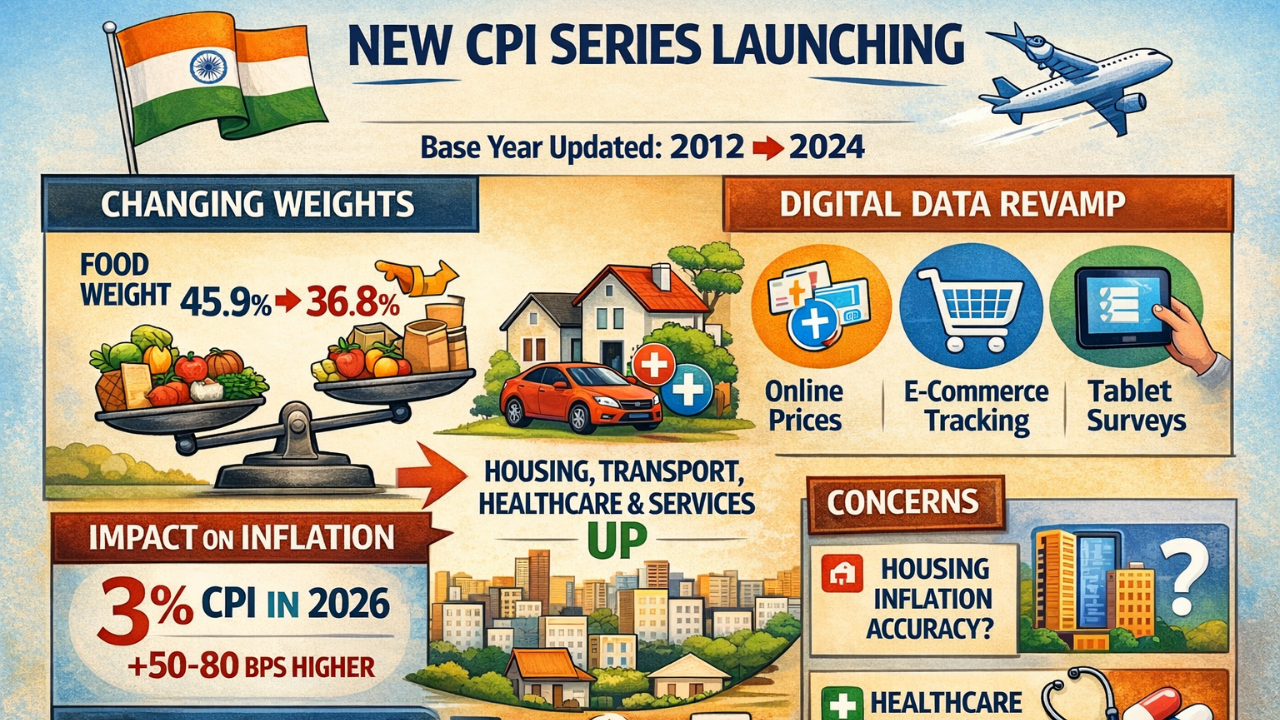
The Indian government is rolling out a revamped Consumer Price Index (CPI) series on Thursday, February 11, updating the base year from 2012 to 2024. This shift incorporates findings from the Household Consumption Expenditure Survey, 2023–24, and aims to reflect current household spending patterns more accurately.
At the core of the CPI revision is a reshuffling of weights across spending categories in today’s households. The most significant adjustment is the reduced weight for food and beverages, which drops to 36.8 per cent from 45.9 per cent, with food itself falling from 39.1 per cent to 34.8 per cent. The change reflects evolving consumption patterns and the reclassification of items like prepared meals.
“Food prices are among the most volatile components of CPI, and a lower food weight can materially alter headline inflation prints,” experts note in a Mint report. Meanwhile, categories such as housing, transport, healthcare, and personal services now carry higher weights, increasing their influence on headline inflation measurement. Economists estimate January 2026 CPI inflation could reach around 3 per cent, 50–80 basis points higher than the previous series might have suggested.
Modern Measurement For A Digital Economy
The new CPI series embraces India’s services-led, digital economy. For the first time, online prices, including airfares, OTT subscriptions, and telecom plans, are tracked directly under the series. Data collection now uses tablet-based, geo-tagged systems with real-time validation, improving timeliness and accuracy. Twelve online markets in major cities have been added to capture e-commerce pricing, while centrally regulated items like fuel and electricity draw data from administrative sources.
Structural Overhauls And Methodology Fixes
The revised CPI adopts the UN-endorsed COICOP 2018 standard, aligning India’s inflation framework with international practice. Items like clothing and tuition fees have been reclassified for greater granularity. Methodological issues, such as the treatment of free PDS items and missing prices, have been addressed. Free social transfers are now excluded, and missing values follow a standardised imputation framework, making month-on-month inflation prints more stable.
Despite these improvements, concerns remain about housing inflation accuracy and healthcare weightings. “On the 2012 base year series, housing inflation hovers near historical lows, which contradicts anecdotal data of rising rents in metros and cities,” said Gaura Sen Gupta, chief economist at IDFC First Bank.
Another issue lies in how weights are distributed. Housing’s overall share has risen from roughly 9 per cent to 12 per cent, but this includes rural housing, where rental inflation is typically much lower, potentially pulling down the overall housing inflation figure. Likewise, uncertainties persist regarding whether the health component accurately reflects real healthcare costs, as specific methodological adjustments in this area have not been publicly disclosed.
