
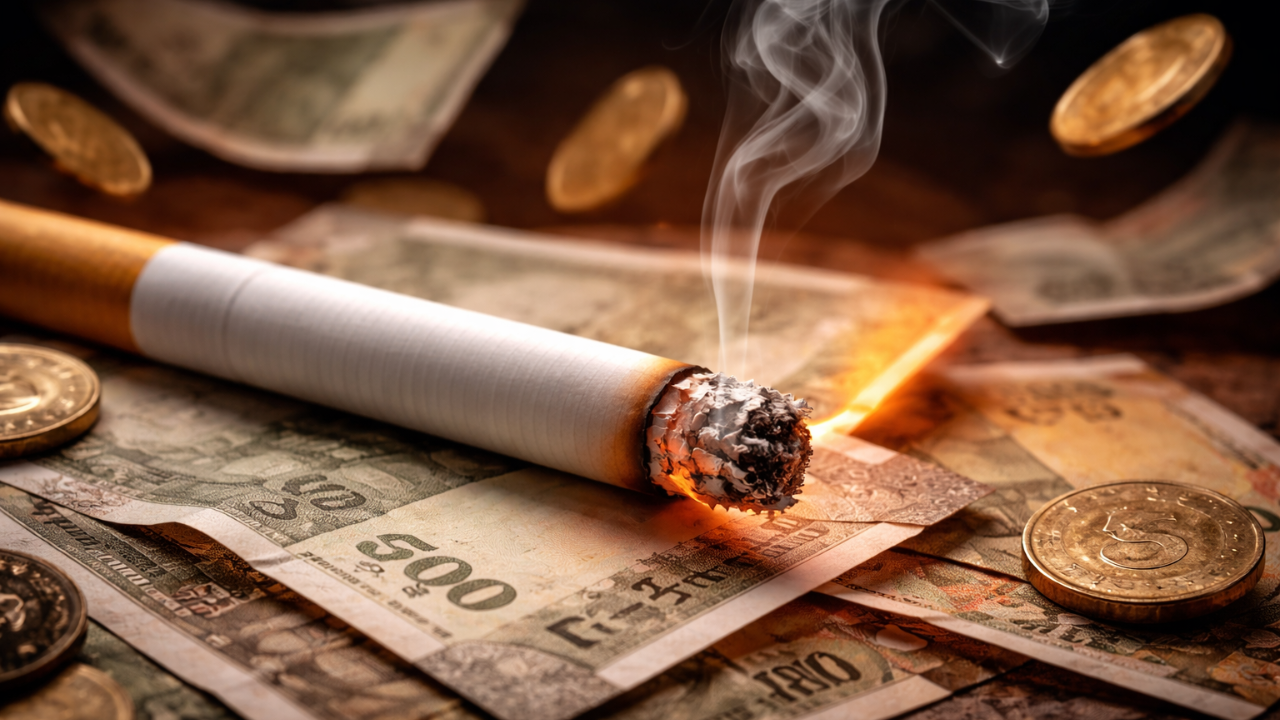
Cigarettes are going to get expensive from February 1 as the government on Wednesday notified revised duties on cigarettes and other tobacco products. The revised tax on cigarettes will be based on the length of the stick and as per reports the prices are expected to go up by 20-30 per cent once these hikes are effective.
The pricing will mainly depend on two factors – the length of stick in millimetres and whether they are filtered or non-filtered. For cigarettes measuring up to 65 mm, the excise duty comes to about Rs 2,700–3,000 per 1,000 sticks, depending on the category. This is the lowest tax slab and applies mainly to shorter cigarettes.
Cigarettes that are longer than 65 mm but up to 70 mm will now face higher tax than shorter ones.
Also Read – Cigarette Prices Set To Rise In 2026: ITC Share Price Dips As India Imposes New Tax
For cigarettes measuring more than 70 mm and up to 75 mm, the excise duty rises sharply to about Rs 7,000 per 1,000 sticks, making them costlier to produce and sell.
The highest tax applies to the “other” category, where the duty is Rs 11,000 per 1,000 sticks. This usually includes longer or specially designed cigarettes that do not fit into standard length categories.
Simply put, the longer the cigarette, the higher the tax.
What does this mean for retail prices?
Companies have not yet announced price hikes, but the new tax structure clearly puts pressure on prices.
For example, a tax of Rs 2,700 per 1,000 cigarettes works out to about Rs 2.7 per stick.
This does not mean prices will automatically rise by the same amount. Cigarette makers may absorb some of the cost to avoid losing customers, especially for popular brands. Others may pass on the cost slowly through phased price increases.
A duty of Rs 7,000 per 1,000 cigarettes translates to roughly Rs 7 in tax per stick.
Similarly, a levy of Rs 11,000 per 1,000 cigarettes works out to about Rs 11 in tax for each cigarette.
In nutshell, shorter cigarettes are likely to see smaller price increases, while longer and premium cigarettes face much higher taxes and are more likely to become costlier.
(Disclaimer: Smoking is injurious to health.)
