
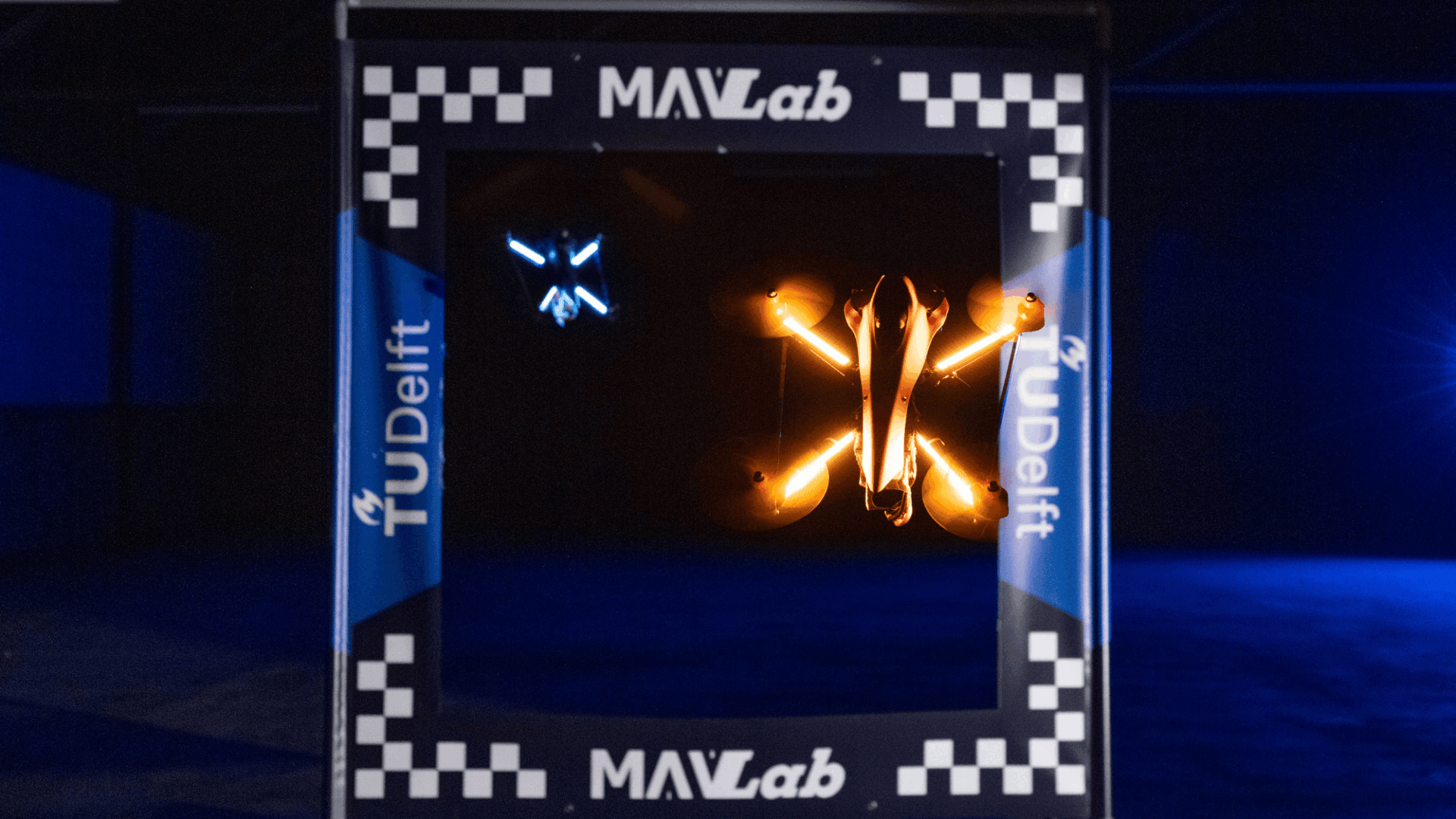
Artificial intelligence is undeniably good at playing games, regardless of its larger societal and environmental impact. In 1997, IBM’s supercomputer Deep Blue famously beat chess grandmaster Garry Kasparov, and nearly two decades later, Google’s AlphaGo managed to defeat a human champion at the much more complex game Go. Since then, another AI seems to beat humans at incredibly complex video games like StarCraft or Dota 2 every few months. Impressive as these feats are, AI has mostly outperformed humans by making us play on its home turf, as in, simulated and structured environments. But now, a team of engineers at the Micro Air Vehicle Lab at the Delft University of Technology in the Netherlands has built a lightweight smart drone that’s fundamentally altering that dynamic.
The team entered its AI-powered quadcopter in a high-profile drone race in Abu Dhabi that pitted AI-piloted drones against human-piloted ones. The niche sport, known as first-person-view (FPV) drone racing, has pilots steer remote-controlled drones through a series of small gates at blistering speeds of 60 to 100 miles per hour. They control the drone by using goggles that give a direct feed into a camera attached to the drone’s front. From a human’s perspective, it’s as if they’re flying through the sky.
The team didn’t just fish the race. They took first place, besting several human FPV champions along the way. It marked the first time an AI-controlled drone beat a human pilot in an international racing competition. Another team from the University of Zurich built an AI-controlled drone that won a race against humans three years earlier, but only in a controlled lab setting. This more recent example showed that a simply trained machine, with minimal onboard sensors and hardware, could be inserted onto a non-controlled test track meant for human operators and still come out on top.
The team won this race in November 2025 but new details about the science behind this achievement are published today in the journal Science Robotics.
“Instead of giving the robot increasingly powerful sensors and computers, we wanted to find out how much intelligence we could extract from very limited resources,” Delft University aerospace engineer and study co-author Christophe De Wagter said in a statement. “Drone racing provided an extreme environment in which to test these ideas outside the laboratory. It pushed us to develop AI that was not only fast but also robust, and able to adapt when external reference measurements were unavailable.”
Drone racing: a sport built on human-machine connectivity
FPV drone racing isn’t for the faint of heart—or, more accurately, for those with a weak stomach. Footage of drones flipping and somersaulting at extreme speeds can make even spectators feel sick. Pilots fly using a pair of joysticks that control the drone’s throttle, roll, pitch, and yaw. That human-and-machine team has to fly through several small race gates that make up a lap. The drone finishing with the fastest lap times wins. It’s an extreme sport where even a microsecond of a mistake can lead to a violent crash.
Though it’s not quite as popular as it was at its peak in the late 2010s, the sport still draws a considerable online audience. That’s pretty impressive, for a sport that only became possible thanks to simultaneous advances in several technologies. Namely lightweight batteries, miniaturized cameras, and the goggles and wireless video links that let pilots see what their drones see all had to come together for this extreme form of racing.
The fact that drone racing requires interacting with machines already equipped with sensors makes it a particularly interesting test bed for robotics and AI researchers. In 2022, the University of Zurich outfitted a drone with an AI model appropriately called Swift. That AI system collected real-time data pulled from the drone camera to “see” what it was seeing and to locate gates and avoid obstacles. An onboard neural network then parsed through all that in real time, making split-second decisions on the best routes to fly. Swift beat champion human pilots, a major feat at the time, but it did so on an indoor track measuring roughly 82-by-82-feet that the team had designed and trained the system for. When a condition even as subtle as the lighting changed, Swift’s performance suffered as a result.
Inspired by those results, the Delft team set out to build an AI racing drone that could better adapt to its environment. Like Swift, their machine called MonoRace uses a powerful AI model that interprets a video stream captured by the drone’s camera in real time. MonoRace also draws on an onboard inertial measurement unit (IMU), a sensor that tracks the drone’s acceleration and rotation. This IMU pulls data from onboard sensors as well as the camera, and helps the AI system better understand where the drone is position-wise on the track.
Timelapse image of the autonomous MonoRace racing drone flying through the final racing gate at Abu Dhabi in 2025. Image: Micro Air Vehicles Lab/Delft University of Technology.
That understanding of place makes it more equipped to fly without crashing even in less familiar environments. It also improves the drone’s perception over a solely camera-based approach, which can struggle when camera data is less than stellar. Remember, all of this is happening very, very fast.
“Flying at very high speed with only one camera is challenging because the images are blurry, deformed, and the AI system has very little time to precisely determine where the drone is,” Delft University robotics researcher and study co-author Stavrow Bahnam said in a statement. “We developed a robust way of combining what the camera sees with the drone’s own motion information, allowing it to navigate the track at high speed without GPS.”
What sets MonoRace apart from complex AI systems running on larger vehicles or humanoid robots is how stripped down it is. The entire system has to run on a tiny computer on the drone, light enough not to slow the drone down and efficient enough not to introduce lag. And yet, it’s still quite powerful, with the AI issuing an estimated 500 commands every second. Rather than train the model on one specific track, they trained it to learn how to adapt using a reinforcement learning approach. After many attempts of trial and error in a simulated environment, MonoRace figured out the best ways to quickly solve navigation problems and then apply that in the real world.
“Instead of first planning a desired flight path and conventional commands, our neural network learns to directly control the motors,” study co-author and Delft University Aerospace Engineering PhD candidate Robin Ferede added in a statement.
Putting MonoRace to the test
The team put MonoRace to the real test last November at the Abu Dhabi Autonomous Racing League, a major competition where some of the best human pilots battle to out. During its flights, MonoRace topped speeds of roughly 62 miles per hour as it looped, dove, and zipped through gates. It managed to beat out every other AI racing team in the competition, and also boasted a better time than three former human world champion pilots.
According to the team, these results make MonoRace the first AI-piloted drone to beat human pilots in an international racing competition, and could have an impact on drone racing and physical AI more broadly. With self-driving vehicles and even some humanoid robots entering larger-scale production, there’s an increasingly high demand to build AI systems that better grasp how to move about the physical world without barreling into everything around it. A drone that can do that while performing acrobatics at more than 60 miles per hour suggests that engineers are, at minimum, heading in the right direction.
So far, that hasn’t resulted in larger robots suddenly superseding humans at sports. The fastest robot sprinters, though admittedly quick in short bursts, also tend to crash into walls and burst into flames.
The post An AI-racing drone beat the best humans and set a world record appeared first on Popular Science.
