
Few creatures wear the mantle of deep time as visibly as Limulus polyphemus, better known as the Atlantic horseshoe crab. To walk through the gravelly shores of the Delaware Bay or the back-bay shallows near Ocean City, New Jersey during the high spring tides of June is to witness a gathering unchanged since the Triassic.
Horseshoe crabs draw tracks in the sand with their six pairs of legs. Image: Susan Allen/@what.sue.seas.
Here, the ancient arthropods—who have existed for roughly 445 million years—assemble for their great spawning. Under the gravitational pull of the full moon, king tides cue the helmet-shaped crabs to emerge from the depths of the Atlantic Ocean. The females, robust and broad-carapaced at nearly two feet in length, plow into the damp sand at the water’s edge. They then deposit thousands of eggs beneath the slurry of the surf.Each tiny, colorful orb is barely larger than a mustard seed.
Horseshoe crabs deposit their egg clusters in the sand, but disturbances from waves, shorebirds and crawling crabs bring loose eggs to the surface where they become easy picking for migratory shorebirds. Image: Susan Allen/@what.sue.seas.
The process works like a precise biological clock, and at dawn, the cycle shifts away from the horseshoe crabs and to the daytime feeders. As the crabs deposit millions of these fatty and nutritious eggs, thousands of migratory shorebirds arrive from the sky. Many of these birds have flown thousands of miles up from the southern tip of Patagonia, only to touch down upon these precise Northeast shorelines. Among them is the Rufa red knot (Calidris canutus rufa), a master of the air executing an annual 9,000-mile odyssey to its Arctic breeding grounds.
A red knot in breeding plumage stalks the shoreline as crabs crawl ashore to spawn. Image: Susan Allen/@what.sue.seas.
Throughout their long journey, red knots can remain airborne for up to a week straight, burning stored energy and losing nearly half of their body mass in the process. The tiny horseshoe crab eggs are an immediate, vital fuel source, allowing the knots to double their weight in a matter of days.
Developing eggs become translucent before the larvae hatch into miniature versions of the adults minus the telson. Image: Susan Allen/@what.sue.seas.
Over the past eight years, New Jersey photographer Susan Allen has captured these spawnings. “The quiet Delaware Bayshore becomes globally significant to the survival of many species each spring,” Allen tells Popular Science. “Hopefully this natural wonder will continue to happen.”
One female crab can be surrounded by a dozen males trying to spawn with her. Image: Susan Allen/@what.sue.seas.
Yet, this ancient convergence faces immediate threats. Climate change is warming bay waters and intensifying storms. In some years, the warmer water has prompted horseshoe crabs to spawn earlier in the season, throwing off the timing that red knots depend on when they arrive to feed on crab eggs.
Red knots stopover at the Delaware Bay during horseshoe crab spawning season to refuel on eggs and hopefully double their weight. Image: Susan Allen/@what.sue.seas.
At the same time, horseshoe crabs have faced mounting pressure from commercial harvest. They are widely used as inexpensive bait in whelk and eel fisheries, and are also collected for the pharmaceutical industry. During the 1990s, harvest numbers surged: in just five years, annual take rose from about 100,000 crabs to 2.5 million.
Horseshoe crabs use their telson to flip themselves over when they get turned upside down. A spiral was drawn by this unsuccessful crab before it perished. Image: Susan Allen/@what.sue.seas.
But against these modern pressures, the endurance of this bird-arthropod partnership remains a profound marvel of prehistoric connection, forged over hundreds of millions of years. The bay is still coming alive as ancient crabs meet the arriving birds in the middle of their long migration.
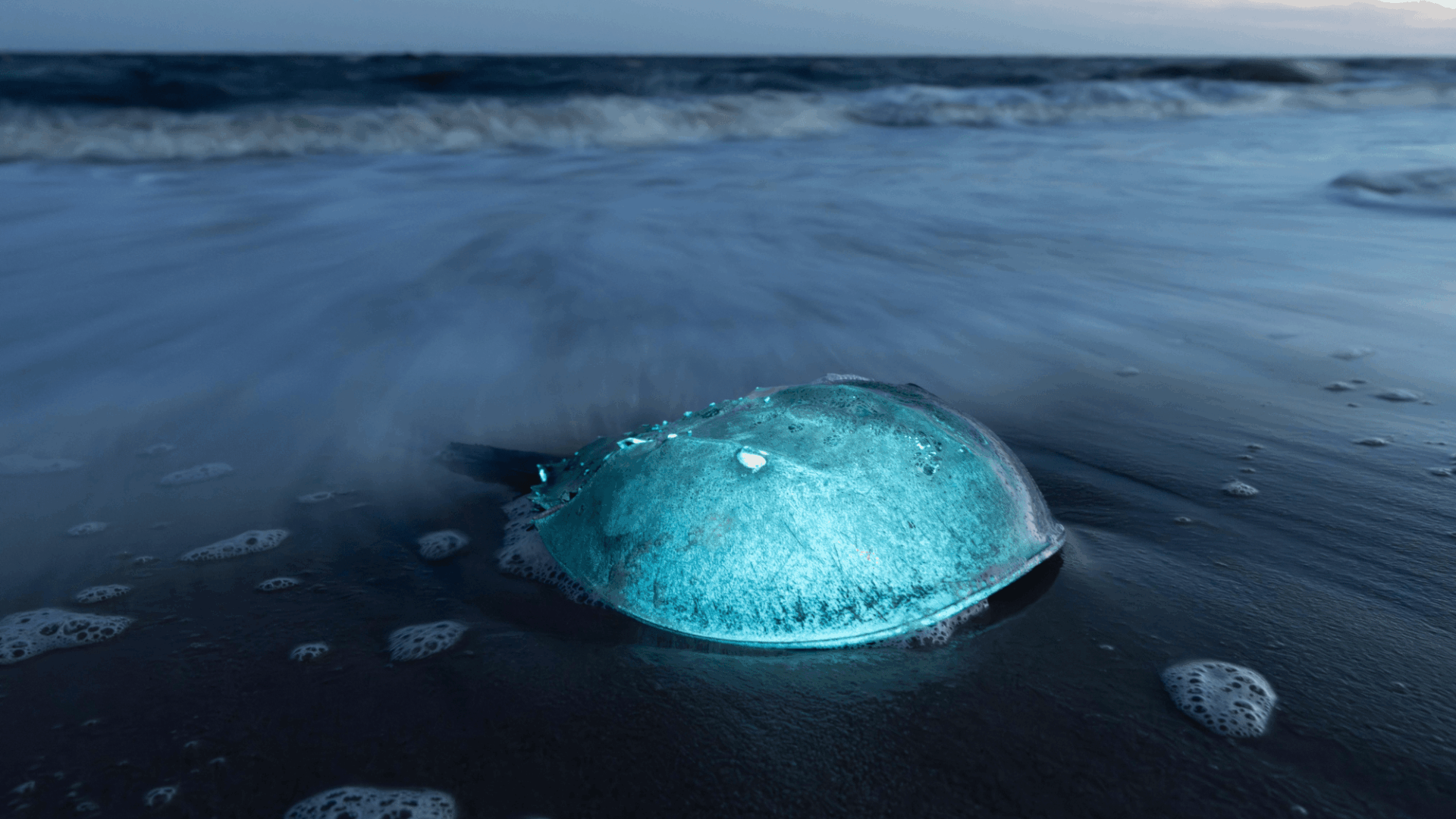
Just like scorpions, horseshoe crabs exhibit biofluorescence under UV light. They also have blue blood that is capable of detecting bacterial contamination. Their blood is harvested by the biomedical industry to test for contamination in vaccines and medical devices, but a synthetic alternative has been developed. Eli Lily has transitioned to using the synthetic alternative for 80 percent of its endotoxin testing. Image: Susan Allen/ @what.sue.seas.
The post 8 captivating photos of Delaware Bay’s annual horseshoe crab spawn appeared first on Popular Science.
8 captivating photos of Delaware Bay’s annual horseshoe crab spawn
