
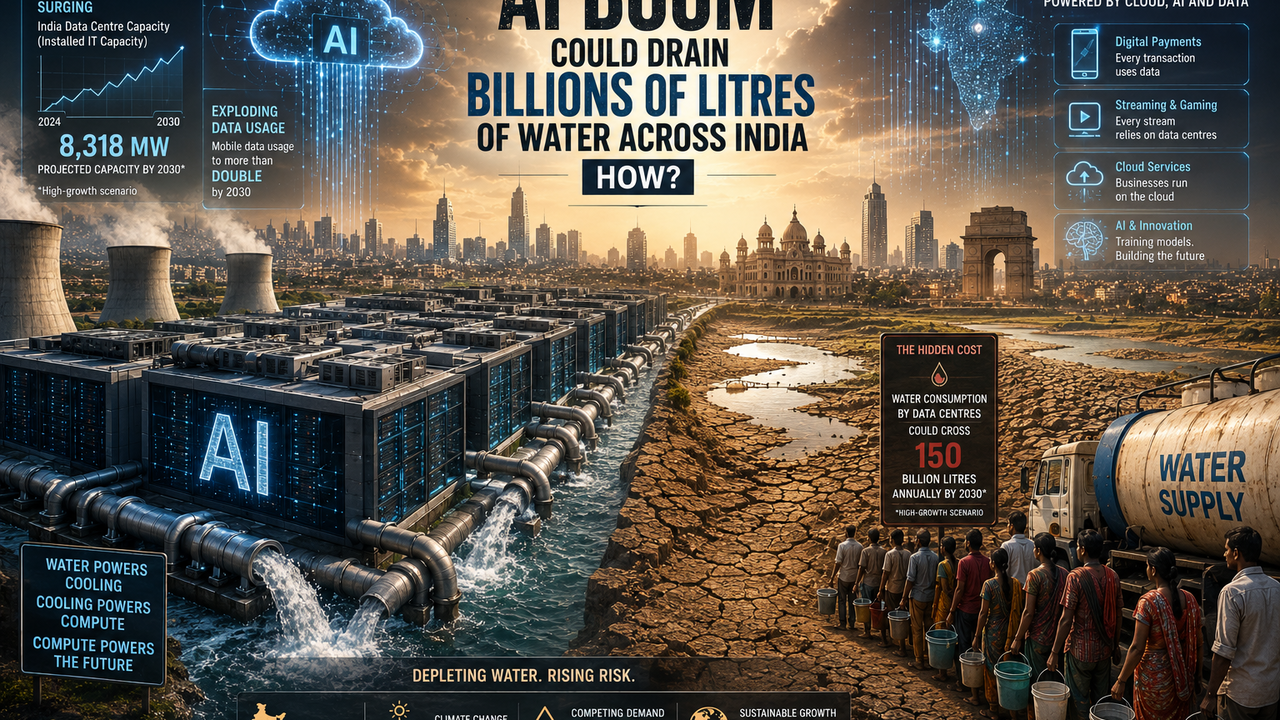
India’s rapidly expanding Artificial Intelligence (AI) and data centre ecosystem could soon place enormous pressure on the country’s water resources, according to a new report on India’s digital infrastructure growth. A report launched by NFPRC-CAIG titled “Beyond Infrastructure: India’s Data Centre Pathway to Digital Sovereignty”, warns that the surge in AI workloads, cloud computing, video streaming and digital services is expected to sharply increase water consumption by data centres over the next few years.
Data centres are the backbone facilities that power AI models, digital payments, OTT streaming, cloud storage and enterprise services. They require massive cooling systems to prevent servers from overheating, and most of these cooling systems consume large quantities of water.
The study projects India’s installed data centre capacity could rise from about 1,352 MW in 2024 to as high as 8,318 MW by 2030 under a high-growth scenario. Alongside this expansion, annual water consumption could surge dramatically depending on the cooling technology adopted by operators.
The concern becomes more significant as many of India’s major data centre hubs including Delhi-NCR, Chennai, Bengaluru, Hyderabad and Pune — are already grappling with periodic water stress and rising urban demand.
Water: Second most critical operational resource
Water has emerged as the second most critical operational resource for data centres after electricity.
The rapid expansion of cloud regions, colocation campuses, and AI-driven compute clusters has significantly increased reliance on cooling systems, many of which require substantial volumes of water.
“Globally, data centres now consume millions of cubic metres of water annually to maintain thermal stability for sensitive IT equipment. In India, where major digital hubs are located in water-stressed and climate-sensitive regions, water modelling becomes central to long-term infrastructure planning,” the report highlighted.
To support evidence-based decision-making, the report developed a city-level Water Usage Effectiveness (WUE) framework that links climate science, cooling engineering, and data-centre design through the following chain: City, Climate Zone, Temperature, Cooling Technology, and WUE.
Water consumption to surge dramatically
The study projects India’s installed data centre capacity could rise from about 1,352 MW in 2024 to as high as 8,318 MW by 2030 under a high-growth scenario. Alongside this expansion, annual water consumption could surge dramatically depending on the cooling technology adopted by operators.
Giving the mathematics behind the water consumption in the operations of data centres, the report said Water Usage Effectiveness (WUE) = 2.1 L/kWh, represents conventional direct evaporative or adiabatic cooling systems typically deployed in hot-dry climates. WUE = 2.8 L/kWh, represents water-intensive cooling tower-based mechanical systems.
For each year, capacity trajectory, and WUE case, annual water consumption is computed as: Annual Water Use = Installed IT Capacity (MW) × 1000 × 8760 × 0.8 × WUE.
Results are aggregated and reported in billion liters per year, enabling direct comparison with municipal, industrial, and basin-level water demand indicators.
The report focuses on direct operational water use from data-centre cooling as this is the component most relevant for local infrastructure planning, siting decisions and regulatory approvals. It further underlines the need for water-secure siting, efficient cooling technologies, circular water-use practices, renewable energy integration and performance-linked sustainability standards to support India’s responsible data-centre grow.
