
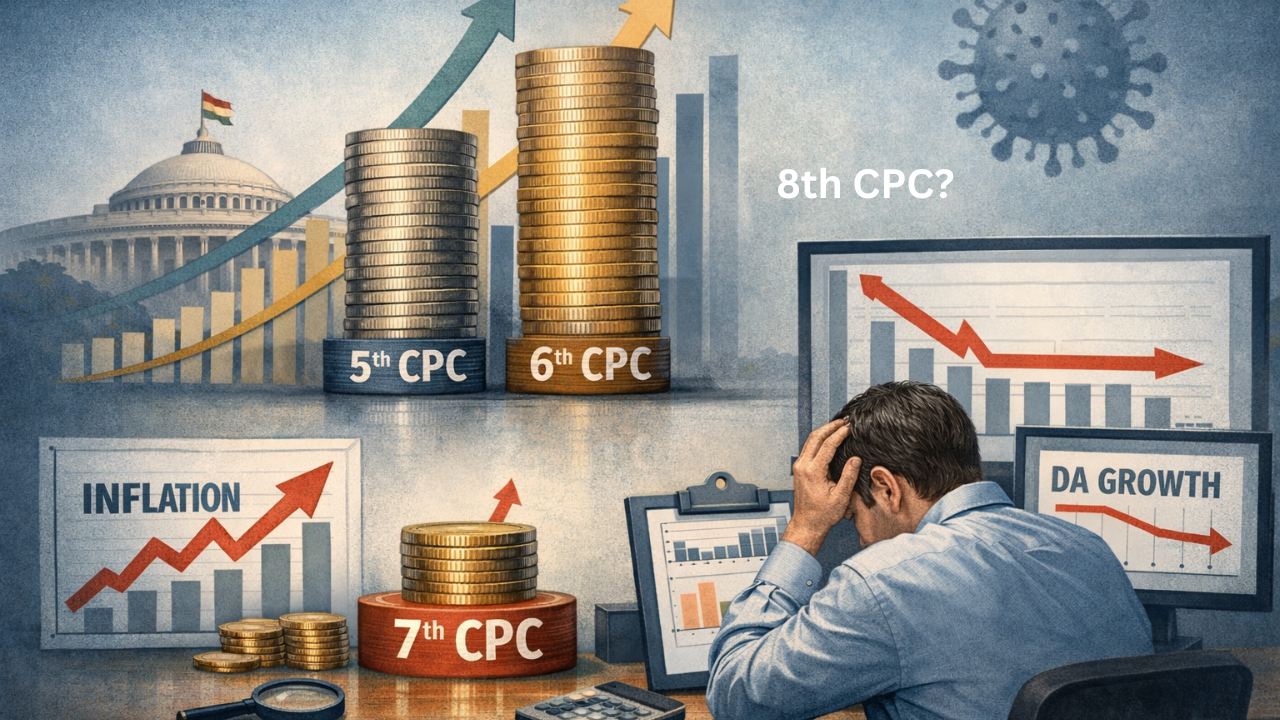
As chatter around the 8th Pay Commission grows louder, central government employees are increasingly focused on one crucial issue: the size of potential arrears once the new pay structure is rolled out. Even without an official announcement on timelines or the effective date, historical patterns from earlier pay commissions offer a useful framework to understand what may lie ahead.
Past pay panels followed a familiar rhythm. Their recommendations were notified well after the previous commission ended, but the revised salaries were backdated. That retrospective application is the key reason arrears mounted significantly for employees in earlier cycles, and it could play a similar role this time too.
Why January 1, 2026, Is Seen As A Likely Starting Point
The 7th Pay Commission’s 10-year term concluded on December 31, 2025. Traditionally, a new pay commission cycle begins from the next calendar day. This convention was followed earlier as well: the 6th Pay Commission took effect from January 1, 2006, while the 7th Pay Commission was applied from January 1, 2016, despite both being implemented later.
Although there is no formal confirmation yet that the 8th Pay Commission will kick in from January 1, 2026, many employees and analysts expect the government to stick to precedent. If implementation is delayed by 18 to 24 months but made retrospective, arrears could accumulate over that entire period.
Looking Back: Salary Movement From 6th To 7th CPC At Level 1
To estimate future arrears, it helps to revisit the last major transition. Under the 6th Pay Commission, salaries were calculated using pay bands and grade pay. For a Level 1 equivalent employee, the basic pay stood at Rs 7,000, with 125 per cent dearness allowance, HRA based on city category, and transport allowance. Gross monthly pay ranged from about Rs 17,350 in Z cities to Rs 19,200 in X cities.
The 7th Pay Commission replaced this structure with a pay matrix. The Level 1 basic pay jumped to Rs 18,000, DA was reset to zero after the merger, and allowances were recalculated. As a result, starting gross pay increased to roughly Rs 20,200–Rs 24,000 depending on the city. The monthly rise worked out to Rs 2,850–Rs 4,800, translating into a hike of nearly 16 per cent–25 per cent.
What A Level 1 Employee Earns Today
Under the 7th CPC, the Level 1 basic pay remains Rs 18,000. However, with dearness allowance climbing steadily, the current DA is assumed at around 58 per cent, pushing the gross salary close to Rs 34,440. If DA rises further to about 68 per cent by the time the 8th CPC is notified, monthly earnings could approach Rs 36,240 even before any revision.
Estimating Arrears Under The 8th Pay Commission
Assuming the next pay commission broadly mirrors the previous approach, using a fitment factor of 2.57 and delivering a hike of around 25 per cent, the revised gross salary could rise to approximately Rs 45,300 per month. That would mean an increase of about Rs 9,060 over the current pay.
If this revision is applied retrospectively for 24 months, total arrears would add up to nearly Rs 2.17 lakh for a Level 1 employee.
Why The Final Number Could Change
These figures are purely indicative and hinge on assumptions rather than policy decisions. The fitment factor could be lower or higher, allowances may be altered, or the government could adopt an entirely new formula. Market estimates already vary widely.
If the 8th Pay Commission follows the familiar pattern of delayed implementation with retrospective effect, arrears could still run into lakhs, even for entry-level staff. For now, the exact payout remains uncertain, with the fitment factor likely to be the decisive element once official recommendations are released.
