
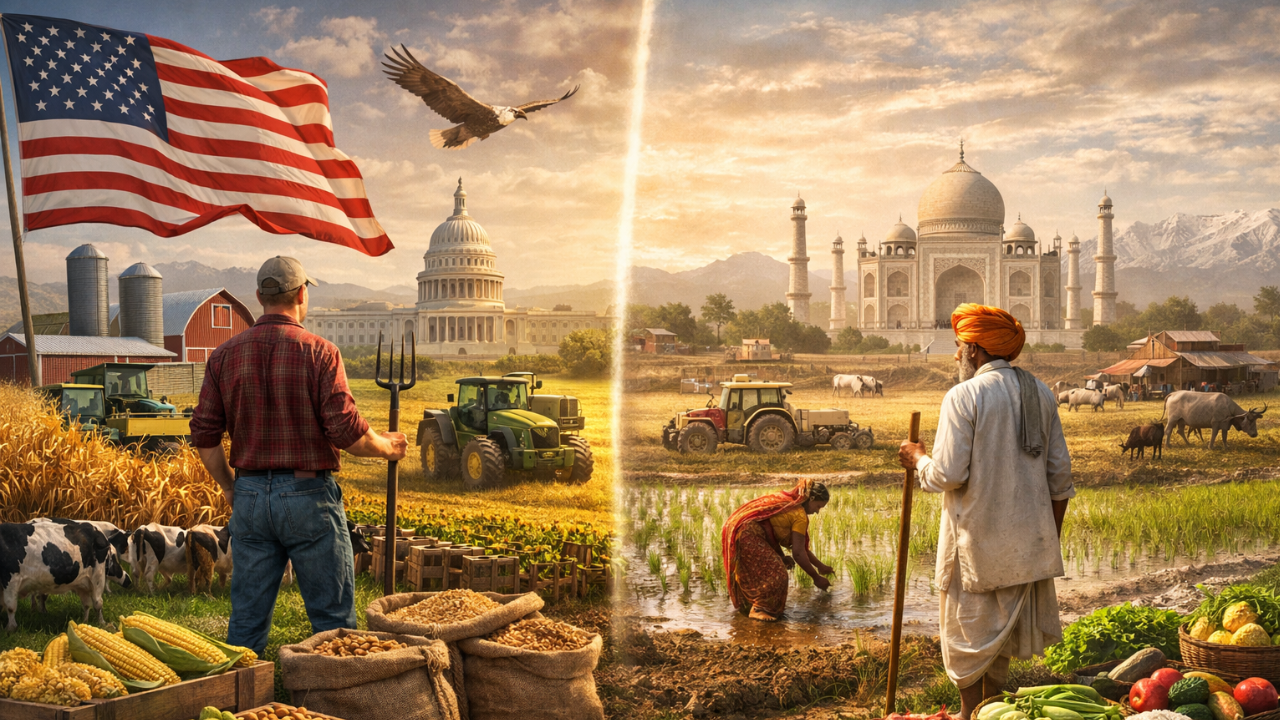
On February 7, 2026, the United States and India unveiled an interim trade framework aimed at reducing tariffs and enhancing bilateral economic ties. This agreement, announced amid President Donald Trump’s push for reciprocal trade and Prime Minister Narendra Modi’s emphasis on ‘Make in India’, follows months of negotiations triggered by US tariffs on Indian goods linked to India’s Russian oil purchases. The deal commits India to eliminating or reducing tariffs on US industrial and agricultural products, while the US lowers its tariffs on Indian exports from 50% to 18%, effective February 7, 2026. India has also pledged to procure up to $500 billion in US goods over five years, including energy, technology, and agricultural items.
Agriculture, a sensitive sector for both nations, features prominently in the deal. The US, a major agricultural exporter, seeks to address its $1.3 billion trade deficit with India in 2024.
India, where farming sustains nearly half of its 1.4 billion population despite contributing only 16% to GDP, has ring-fenced key products to protect smallholders.
Benefits for US Farmers
The interim deal opens India’s vast market—home to a growing middle class and expanding livestock sectors—to US agricultural exports, potentially reversing trade imbalances and boosting rural economies.
Expanded Market Access and Tariff Reductions:
India will eliminate or reduce tariffs on US food and agricultural products, including dried distillers’ grains, red sorghum for animal feed, tree nuts (e.g., almonds, walnuts, pistachios), fresh and processed fruits (e.g., apples, pears), soybean oil, wine, and spirits.
This is expected to widen opportunities for American producers, with US Trade Representative Jamieson Greer noting it “unlocks one of the largest economies in the world for American workers and producers.”
US Secretary of Agriculture Brooke Rollins highlighted that the deal will “export more American farm products to India’s massive market, lifting prices, and pumping cash into rural America.”
Addressing Trade Deficits:
In 2024, the US ran a $1.3 billion agricultural trade deficit with India.
The agreement aims to reduce this by increasing exports, supported by India’s $500 billion procurement commitment over five years.
Sectors like feed ingredients could benefit from India’s expanding poultry and livestock industries, where demand for corn and soybean products is projected to grow.
Relief from Retaliatory Tariffs:
US farmers have suffered from retaliatory tariffs during Trump’s trade wars since 2025, affecting commodities like soybeans and corn.
The deal’s tariff cuts provide relief, potentially stabilizing prices and export volumes.
Issues for US Farmers
Despite gains, the deal’s limitations could frustrate US farmers seeking broader access.
Limited Product Coverage:
India has excluded key US exports like genetically modified (GM) corn, soybeans, soymeal, wheat, rice, dairy, poultry, and ethanol.
Since 95% of US corn and soybean production is GM-based, India’s ban on GM imports severely restricts opportunities.
Incomplete Deficit Reduction:
While targeting the $1.3 billion deficit, exclusions mean the deal may not fully offset losses from other trade wars.
USDA projections for 2025/26 suggest India’s self-sufficiency in corn could limit US gains.
Ongoing Negotiations and Uncertainty:
The interim nature means full benefits depend on a comprehensive agreement by March 2026, with potential delays due to farm standoffs.
Benefits for Indian Farmers
India’s government has prioritized protections, ensuring the deal supports rural livelihoods without exposing vulnerable sectors.
Safeguards for Sensitive Products:
No tariff concessions on staples like wheat, rice, maize, soy, pulses, dairy, poultry, milk, cheese, ethanol, tobacco, certain vegetables, and meat.
This shields 86% of India’s small and marginal farmers (holdings under 2 hectares) from import surges.
Commerce Minister Piyush Goyal stated this “safeguards Indian farmers’ interests and supports rural livelihoods.”
Export Opportunities and Job Creation:
Reduced US tariffs to 18% open a $30 trillion market for Indian exports, benefiting farmers in sectors like shrimp, spices, fruits, and vegetables.
India is a net farm exporter to the US, with strengths in shrimp and other niches.
The deal is projected to create lakhs (hundreds of thousands) of jobs for women and youth in agriculture-related MSMEs.
Stable Prices and Food Security:
By excluding mass-consumption items, the deal prevents price crashes, ensuring stable incomes for horticulture and dairy farmers (average herd size: 2–3 animals).
Issues for Indian Farmers
Critics argue the deal could indirectly harm small farmers through unbalanced competition.
Risk of Dumping and Price Suppression:
Even with protections, potential imports of subsidized US products (US subsidies are 100 times higher per farmer than India’s) could lead to dumping, depressing local prices and affecting livelihoods.
Agri-economist M.S. Swaminathan warned this could be “disastrous” for farmers, health, and ecology.
Opposition Concerns and Political Backlash:
The Indian opposition, including Congress, claims the deal is “pro-US” and harms farmers, potentially fueling protests similar to those against 2021 farm laws.
With farmers as a powerful voting bloc, any perceived threat could amplify discontent.
GM Crop Debates and Long-Term Reforms:
Exclusions highlight tariff complexities and GM issues, but experts like Ashok Gulati call for domestic reforms to make Indian agriculture competitive.
Comparative Analysis
US and Indian farmers operate in starkly different contexts, shaping the deal’s asymmetric impacts. US agriculture is large-scale and heavily subsidized ($1,000 equivalent per farmer vs. India’s $10), enabling export aggression but limiting gains due to India’s GM bans and exclusions.
Indian farmers, predominantly smallholders (86% marginal), benefit from robust protections but face dumping risks, unlike US farmers who gain from market expansion.
Data shows India as a net exporter to the US, but the $1.3 billion deficit favors India, which the deal partially addresses for the US.
Overall, US farmers secure export boosts (e.g., nuts, fruits) worth potential billions, while Indian farmers prioritize stability over aggressive gains, reflecting India’s focus on food security for 700 million rural dependents vs. the US’s 2% workforce in agriculture.
Aspect
US Farmers
Indian Farmers
Scale
Large herds (hundreds of animals); industrial focus
Small holdings (86% <2 ha); 2–3 animals per herd
Subsidies
High ($1,000 equiv./farmer)
Low ($10 equiv./farmer)
Trade Position
Deficit with India ($1.3B in 2024); gains limited access
Net exporter; full protections on staples
Benefits
Export growth in feed, nuts, fruits; price lifts
Job creation, export access; price stability
Issues
Exclusions on GM crops, dairy; incomplete deficit fix
Dumping risks; political backlash
The 2026 US-India interim trade deal offers targeted benefits for US farmers through market access and deficit reduction, while posing challenges from product exclusions. For Indian farmers, protections ensure minimal disruption, with export opportunities as a bonus, though dumping fears loom. Comparatively, the agreement favors US export ambitions but underscores India’s defensive stance to safeguard its vast rural base. As full details emerge by March 2026, monitoring implementation will be key to assessing long-term effects.
