
Union Finance Minister Nirmala Sitharaman is all set to present the Budget for the financial year 2026-2027 in the parliament on Sunday, February 1. With major expectations from taxpayers and businesses, the citizens are restless to witness what the government has in its bag this time.
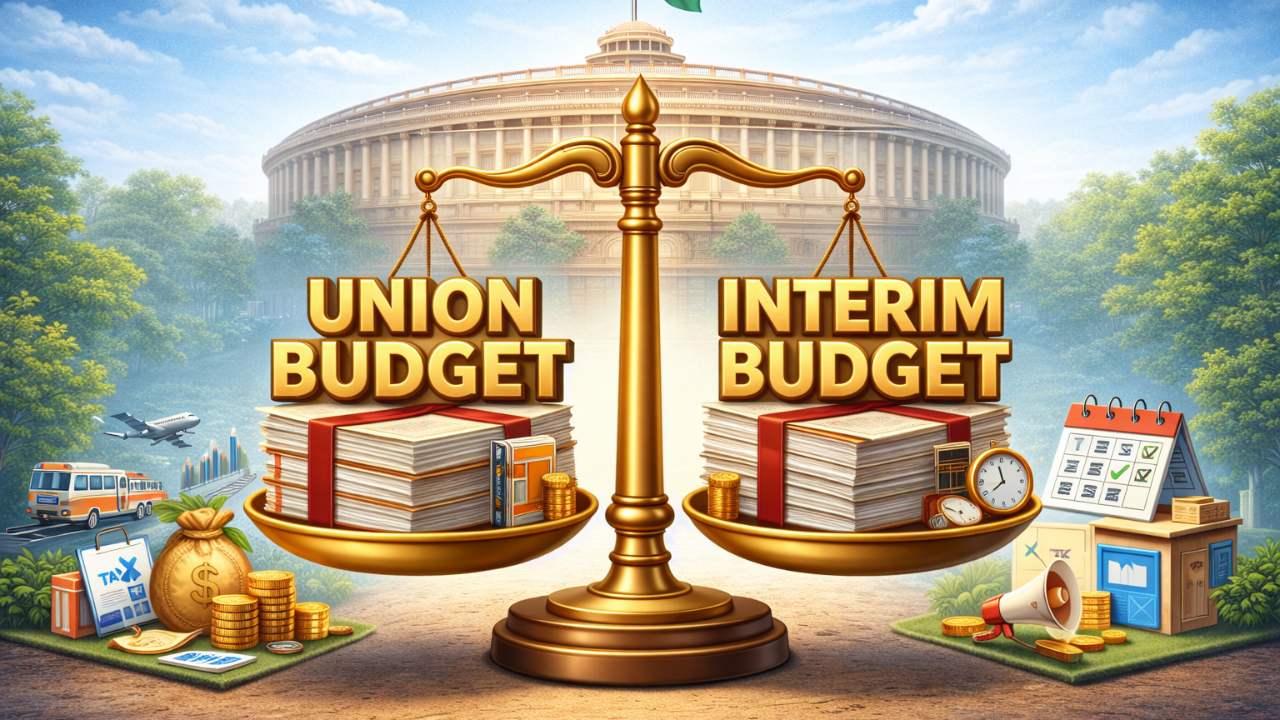
Additionally, as the nation awaits another budget season, there is a common confusion among citizens about what exactly an Interim Budget is and how it is different from the Union Budget.
What Is A Union Budget?
The Union Budget is the annual financial statement of the country. It is a comprehensive financial plan for a full financial year, April 1 to March 31. Prepared by the Ministry of Finance and presented in the parliament under Article 112 of the constitution by the finance minister, it outlines the government’s expected revenues, expenditures, tax proposals, and resource allocations to sectors such as education, infrastructure, health, defence and more.
Main Bhi Finance Minister: Create Your Own Union Budget 2026 Here
Traditionally, the Union Budget is presented on February 1 or the first working day of February, followed by debates and voting in both the Lok Sabha and Rajya Sabha. Typically, it includes new taxes, policy reforms, welfare schemes and financial targets for the entire year.
Union Budget 2026 will be presented on February 1, a Sunday, which has occurred only once before, in 2000.
What Is An Interim Budget?
An Interim Budget is a temporary financial plan presented only when a complete Union Budget cannot be prepared in time, especially because general elections are in the near future or a new government is about to be formed. The goal is to ensure uninterrupted government functioning until the next government prepares and presents a full budget.
Contrary to a regular budget, the Interim Budget typically avoids major policy changes, long-term schemes, and new tax slabs, because the new government might have its own set of priorities. Despite no legal prohibition on announcements, governments traditionally refrain from making large commitments in an Interim Budget.
An Interim Budget usually includes estimates of revenue and expenditure, and often accompanies a “vote on account”, a parliamentary approval that allows the government to withdraw funds for essential expenditures such as salaries, subsidies and ongoing programmes for the interim period.
Before the 2024 general elections, India saw an Interim Budget on February 1, 2024, to bridge the fiscal planning gap till the new government took over later in the year.
Key Differences Between Interim Budget and Union Budget
Even though both are presented in the parliament, the Union Budget and Interim Budget differ in scope, intent and political scope.
Purpose
The Interim Budget ensures the smooth functioning of the government when a full-fledged budget cannot be completed in time, whereas the Union Budget lays down the government’s entire financial roadmap for the year.
Timing
An Interim Budget is presented in an election year or when a government’s term is ending, while the Union Budget is presented annually, ahead of the new financial year, usually on February 1.
Duration
Interim Budget is valid for a short period of usually 2-4 months, while the Union Budget is valid for the whole financial year.
Announcements
Major policy decisions are traditionally avoided in an Interim Budget. On the other hand, the Union Budget includes policy reforms, welfare schemes, and development initiatives.
Taxes
Significant tax changes are avoided in an Interim Budget, while they are subjected to change in the Union Budget.
Approval
The Interim Budget focuses only on the “Vote on Account”, requiring approval only in the Lok Sabha. On the contrary, the Union Budget requires a discussion and approval in both Houses of Parliament.
Context
An Interim Budget is presented by the outgoing or caretaker government. The Union Budget is presented by a government with a fresh
electoral mandate.
Impact
An Interim Budget ensures short-term continuity, while the Union Budget shapes the broader economic landscape.
Also Read: Budget 2026: 12 Lesser-Known Facts About India’s Annual Financial Statement
