
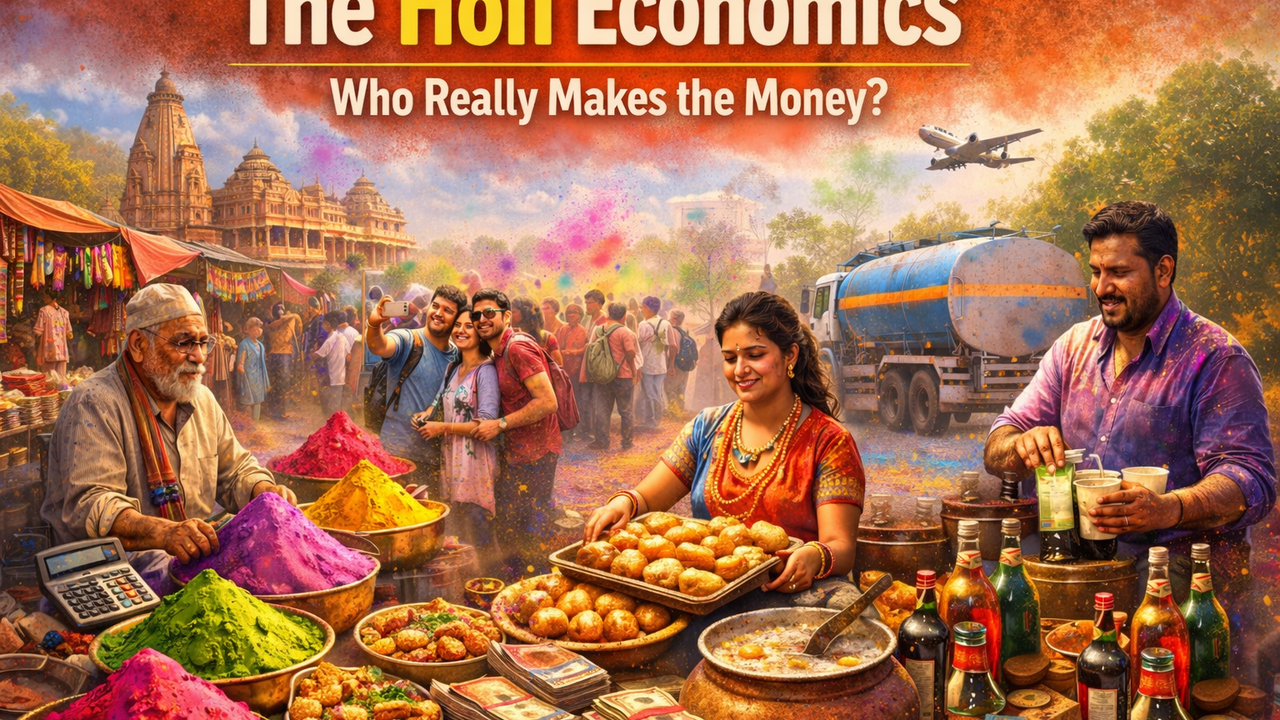
Start with a simple fact. Holi is not Diwali. Diwali has a clean, traceable economy — gold receipts, electronics invoices, automobile dispatches, GST filings that spike. Holi’s economy is almost entirely consumable and cash-driven. Everything bought for it gets eaten, smeared (with colours), drunk (take a pick!), or washed away at max within 48 hours. That makes it harder to measure, harder to tax, and in many ways, more interesting (read complicated) to understand.
This year, the Confederation of All India Traders (CAIT) has put a headline number on it: Holi 2026 is expected to generate business exceeding ₹80,000 crore, up from an estimated ₹60,000 crore last year — nearly 25 percent growth in a single year. CAIT Secretary General and MP Praveen Khandelwal has attributed part of this surge to the Prime Minister’s Vocal for Local push, pointing to a marked decline in Chinese goods in Holi markets since 2021 and rising demand for Indian-made colours, pichkaris, and festive apparel. Delhi alone, according to CAIT, is expected to account for ₹15,000 crore of that trade.
These are trader-body estimates, not government statistics, and they come with the usual caveats about methodology. But directionally, they confirm what anyone walking through Lajpat Nagar, Chandni Chowk, or any district market in UP can see — Holi is serious business. The question is: for whom, exactly?
“The economy related to Holi that is manifested in the purchase of colors, sweets, dry fruits, drinks, clothes, small gifts, gatherings, travel, hospitality, and activities that are informal, the broad economy can be estimated to be around ₹60,000–₹80,000. This is small in comparison to the ₹300 Lakh Crore of the Indian economy, meaning it is 0.3% of the Indian economy. However, the volume of this trade in an informal economy is significant. Most of this trade transpires in approximately 2-3 weeks of the holiday. In an informal economy, the sweets and confectionary trade can experience an increase in demand for 8-12% and in the informal trade of colors and water accessories, 60-714% of the annual trade are related to the festival. Holi is no big deal to the overall economy but to the economy of the informal sector it is very significant,” said, Siddharth Maurya, Founder & Managing Director, Vibhavangal Anukulakara Private Limited
Holi has become a “high-frequency consumption event that triggers the entire mass market in India,” said Ridhima Kansal, Director, Rosemoore.
“Through consumption modeling and the Direct and Indirect Spending Model, the Holi economy is valued at approximately ₹75,000 to ₹1,00,000 crore. This includes retail and FMCG data. What is strong about Holi is the Participation Scale. If we take a snapshot and estimate that 300 million households in India? If 25–30% households spend during Holi, and each household festive spend is between ₹2,500 and ₹4,000, the total spending becomes quite significant. Consumer surveys have shown that more than 60% of urban households spend on something for Holi, be it sweets, colors, new clothes, or a gathering,” Kansal said.
Colour Manufacturers: The Obvious Winners (With an Asterisk)
The colour industry is the most visible piece of the Holi economy, and it’s undergoing a genuine structural shift. Synthetic colours — long dominant because a packet could be had for ₹10–20 — are losing ground to herbal alternatives made from flowers like tesu (Butea monosperma), turmeric, beetroot, and sandalwood. Herbal gulal now retails for ₹80–300 per packet. The margin profile is entirely different, and the MSME units in Rajasthan and Uttar Pradesh that pivoted early to herbal production are now in a strong position.
The Vocal for Local dynamic CAIT describes is real in this category. Chinese-made colours and plastic water guns had made significant inroads into Indian Holi markets through the mid-2010s. That has reversed sharply since 2021 — partly policy, partly consumer preference, partly the post-COVID sensitivity around Chinese goods. Indian pichkari manufacturers, concentrated in UP and Gujarat, have been the direct beneficiaries.
“From the perspective of industry leadership, the Swadeshi shift during Holi is more structural than symbolic,” said Kansal, adding that “consumer preference studies reveal that around 70% of consumers say they would buy Indian-made festive products, provided the quality is acceptable.”
“Over the last few years, the trend of importing water accessories and colours has been replaced by Indian manufacturers fulfilling the majority of organised retail demand. Moreover, Indian MSMEs have led the production of the eco-friendly and skin-safe colours which have the highest growth rate of all categories in Holi products, reflecting the heightened health consciousness and concern for sustainability. We are witnessing the growth of conscious consumption, a result of the development of our local manufacturing capabilities, and the Swadeshi shift,” Ridhima Kansal said.
Maurya said that the last 5 years of policy focus on “Vocal for Local”, increased scrutiny on imports, and heightened consumer awareness have shifted seasonal markets towards Indian products. Industry analysis reports that in organised retail for colours and water accessories, Indian manufacturers have more than 80% of the market. In addition, the segment of herbal and eco-friendly colours, that is dominated by Indian MSMEs, is reported to be growing at more than 10% per annum.
The asterisk, though, is important. A significant share of colour production still happens in entirely informal workshops in Kannauj, Mathura, and Vrindavan — small units producing unbranded synthetic powders, employing piece-rate workers for a six-to-eight-week production window. When CAIT talks about the colour market booming, it’s worth asking how much of that boom reaches these workers, who have no contracts, no health insurance, and no work once the season ends.
Sweet Shops and the Mithai Economy
Walk past any halwai shop in Lucknow, Varanasi, Mathura, or Old Delhi in the week before Holi and you’ll see the same thing: mountains of gujiya, the half-moon fried pastry stuffed with khoya and dry fruit that is to Holi what the modak is to Ganesh Chaturthi. It is not an all-year product. It is made in a window, sold in a window, and gone. No, the infamous ‘sonpapdi’ has no place in Holi.
A well-established sweet shop in Old Delhi or so can move 500 to 2,000 kilograms of gujiya in the three to four days before Holi, according to reporting by The Hindu and regional newspapers. At ₹400–800 per kg for premium variants, that’s a concentrated revenue spike that can represent a meaningful share of a halwai’s annual income.
CAIT’s data captures this too — sweets, dry fruits, gift items, and groceries are explicitly listed among the categories driving this year’s ₹80,000 crore estimate. The organised end of this market — Haldiram’s, Bikanervala, ITC and many such brands — has moved aggressively into festive hampers priced at ₹500–2,000. Whether this is cannibalising the neighbourhood halwai or serving a different customer entirely is a question worth asking. For now, both seem to be doing well. The demand isn’t a fixed pie.
Thandai — the milk, almond, and rose drink that is Holi’s unofficial official beverage — has also grown into a small premium segment of its own. Packaged mixes now target the Indian diaspora abroad, turning a hyperlocal festival drink into a modest export product.
The Travel Sector: Vrindavan’s Visitor Economy
No other place in India monetises Holi the way Mathura and Vrindavan do (at least visibly so). The Braj region doesn’t have one Holi — it has nearly two weeks of them, beginning with Lathmar Holi in Barsana, where women ceremonially beat men with sticks to the delight of thousands of cameras, and ending with Rangwali Holi. The entire sequence has become one of India’s most distinctive cultural tourism products.
Over one million domestic and international tourists land in the Braj region during the Holi season, according to the estimates of the Uttar Pradesh tourism department. Hotels in Mathura and Vrindavan report 90–100% occupancy in the week before Holi, and of course room rents skyrocket in comparison to the rest of the year, according to reporting by the Times of India and hotel industry data.
Alcohol Sales: The Unofficial Economy
This is the sector where data is thinnest by design. State excise departments don’t publish festival-wise revenue breakdowns. But industry sources cited by Business Standard and Livemint have consistently noted that beer and ready-to-drink category sales hit their highest single-day volumes of the first quarter on Holi, particularly in urban markets. Bars and restaurants in metros run Holi brunches at ₹1,500–4,000 per head, bundling open bars with colour play.
Water Tankers: The Unglamorous Winner
This is the part of the Holi economy that gets no coverage — and possibly the part with the most naked pricing power.
Large portions of Delhi, Jaipur, Lucknow, and peri-urban India depend on private water tankers because piped supply is either absent or unreliable. Holi dramatically spikes water demand — not just for the festival itself, but for everything that follows. Tankers in Delhi’s periphery that normally cost ₹600–800 for 5,000 litres routinely fetch ₹900–1,200 in the days surrounding Holi — a 30–50% premium, according to consumer complaints reported by the Hindustan Times and NGO water access studies. The tanker business, however, is entirely unorganised — privately owned vehicles, informal operations, zero consumer recourse. That combination of essential service, captive demand, and zero regulation is about as close to a perfect pricing opportunity as any small business gets.
What the number does capture, even approximately, is something real: Holi has become a major consumption event that cuts across categories in a way that few festivals do. Colours, sweets, clothing, dry fruits, travel, hospitality, FMCG, consumer durables — CAIT lists all of them as contributors, and that breadth is accurate. This is not a festival with a single dominant category. It’s a broad-based spending moment.
“The end of the financial year is marked by spikes in impulse spending. This can be correlated with Holi, as India’s Private Final Consumption Expenditure (PFCE) is 58% of the GDP, while sentiment spikes in March help close the fiscal year stronger. Reports show the discretionary spending category sees a huge 12-18% demand increase,” Kansal said.
The deeper story is also about where the money flows. Unlike Diwali — where organised retail, jewellers, and electronics companies capture most of the value — Holi’s economy runs primarily through people who are hard to count: halwais, informal colour workers, tanker operators, local guides in Vrindavan, seasonal packers in Rajasthan. When ₹80,000 crore moves through an economy this fragmented, a lot of it never touches a bank account, never generates a receipt, and never shows up in any official measure of growth.
