
For nearly 60 years, the first humanmade object to successfully land on the moon has been missing. However, researchers may now be closer than ever to finding the Soviet Union’s Luna 9 spacecraft. Using an advanced machine learning program, an international team of scientists believe they have finally narrowed down a list of finalists for Luna 9’s location. Their evidence is laid out in a study recently published in the journal npj Space Exploration.
The case of the missing lunar lander
While the United States beat the USSR to landing a human on the moon on July 20, 1969, that outcome was anything-but-certain only three years earlier. For a moment, the Soviets even appeared on their way to victory after engineers successfully achieved a soft lunar landing with their Luna 9 spacecraft on February 3, 1966. Luna 9 was also the first to send back photographs from another celestial object.
However, unlike Neil Armstrong or Buzz Aldrin’s footprints, no one has had a clear idea about the USSR probe’s location on the moon for decades. Part of this is due to outdated calculations, as well as Luna 9’s unique landing method. Before the spacecraft touched down, it deployed a spherical landing capsule built with inflatable shock absorbers. These allowed it to safely bounce multiple times before reaching a stop.
After the mission’s conclusion, the Soviets published their estimated landing coordinates in the newspaper, Pravda. Since then, the exact location has remained a matter of debate. In 2009, imaging from NASA’s Lunar Reconnaissance Orbiter Camera (LROC) confirmed the big issue: Luna 9 wasn’t where it was supposed to be. What’s more, there’s a chance that it’s miles away from where experts thought.
YOLO!
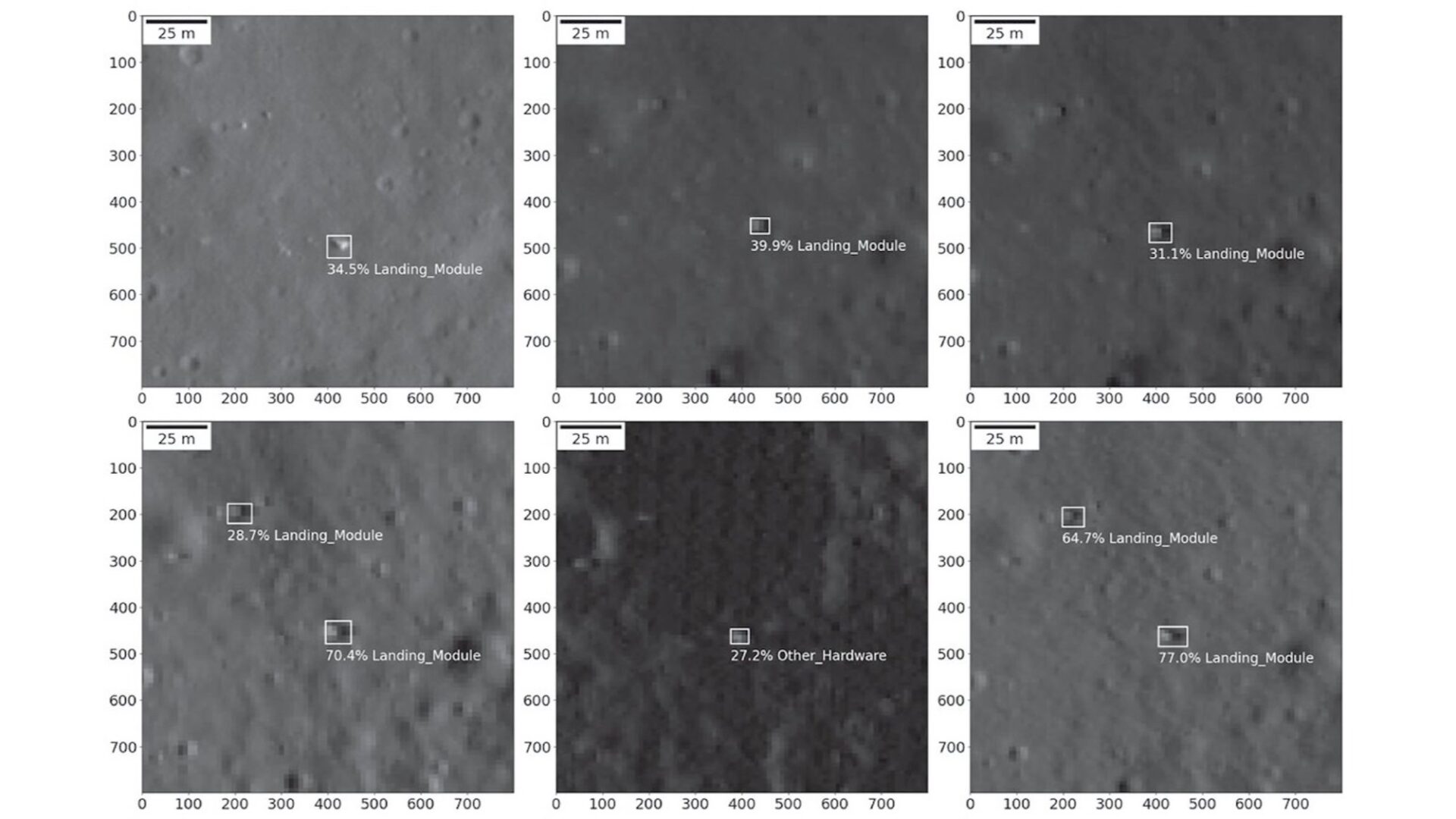
To keep up the search, University College London data scientist Lewis Pinault recently began designing a machine learning algorithm by training it on LROC imagery of multiple Apollo landing sights. Named the You-Only-Look-Once—Extraterrestrial Artifact (YOLO-ETA), the program was eventually good enough to identify hard-to-discern surface features created by landers. The team tested YOLO-ETA on unfamiliar images, including some of the USSR’s Luna 16 that landed in 1970. Across the board, the program displayed a high level of accuracy and confidence in its estimations.
Finally, it was time to task YOLO-ETA with its biggest mission yet. Researchers instructed it to scan the roughly 3.1-by-3.1 mile Luna 9 landing area listed in Pravda’s article. YOLO-ETA returned with multiple possible locations worth a closer look—each one displaying potential signs of artificial lander disturbance on the lunar soil.
Luckily, it won’t take another six decades before the team knows if any of these contenders are correct. India’s Chandrayaan-2 orbiter is scheduled to pass over the area in March 2026 as part of its ongoing surface mapping project. From there, researchers will be able to compare their landing sites with the high-definition data, possibly ending a longtime space mystery.
The post Astronomers close in on long-lost Soviet lunar lander appeared first on Popular Science.
Astronomers close in on long-lost Soviet lunar lander
