
Audi is having a big moment: two years ago, the German brand announced it would launch 20 brand-new or significantly new models. Twelve of those have already rolled out, with more coming soon. The automaker also unveiled the Concept C, an all-electric two-seat sports car that looks like a cross between a TT and an R8. Audi says the Concept C “previews a future production model” but with the EV market currently in flux it’s impossible to say what happens next.
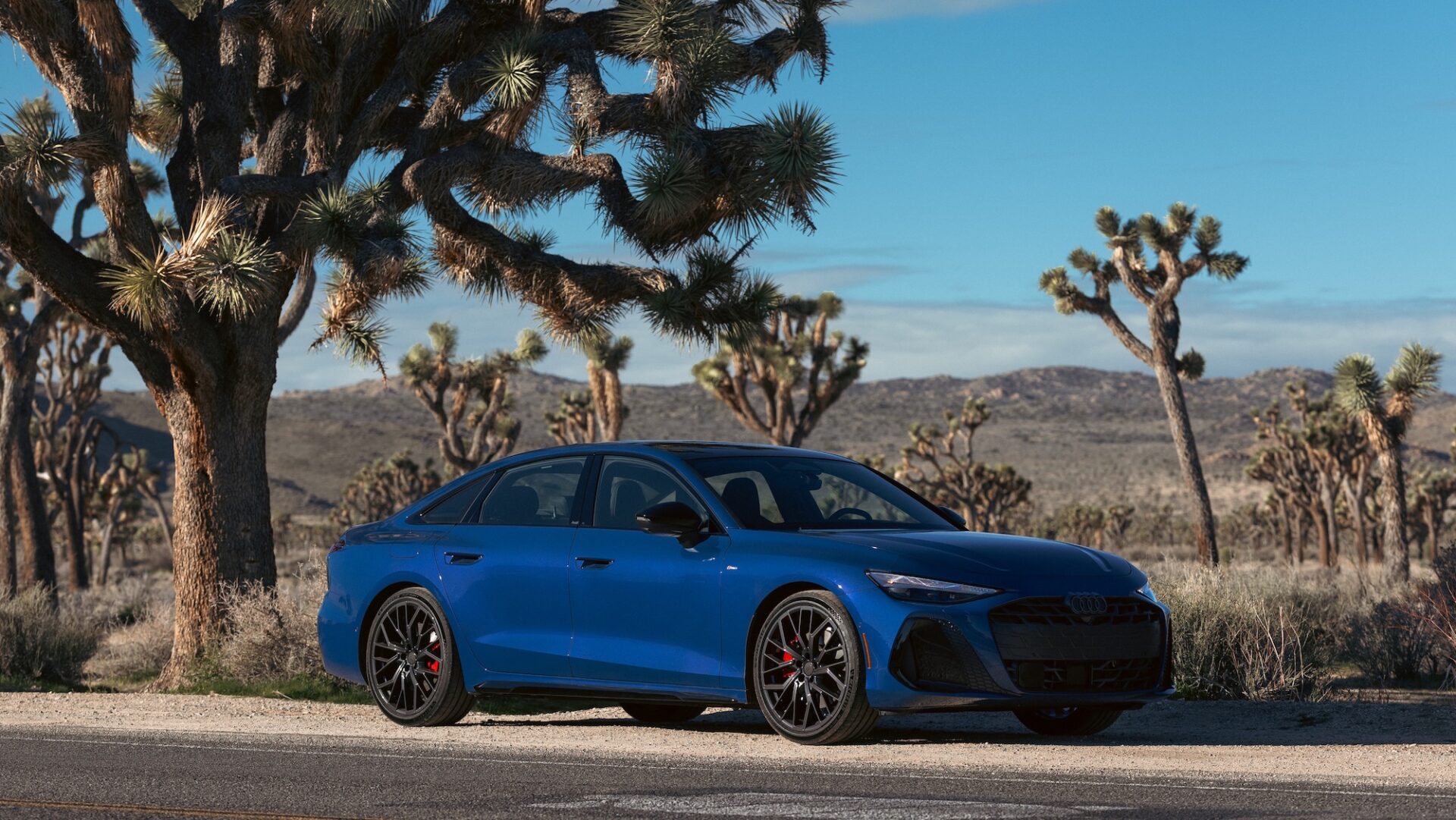
Meanwhile, Audi took the wraps off the newest version of its compact luxury sedan, the A6. Now in its 9th generation, the A6 is powered by a 6-cylinder gas engine making 362 hp and 406 lb-ft of torque. It zooms from 0 to 60 mph in a brisk 4.5 seconds and includes more safety features, including an additional airbag up front.
The tech is updated too, with a new 14.5-inch OLED as standard instead of the 10.1-inch LCD display. A high-resolution dashcam is integrated directly into the base of the rear-view mirror, capturing high-resolution 4K videos even in low-light situations. It’s even equipped with a standard electrochromic glass roof that uses liquid crystals to shift from clear to opaque in six seconds at the touch of a button.
But the real magic is in the A6’s handling, led by its electromechanical progressive steering.
With new tech, more safety features, and a standard high-resolution dashcam, the A6 is stacked. Image: Audi
The advent of power steering
If you look at the history of steering engineering and technology, we’ve come a long way from cars that weren’t easy to wrangle on varying road surfaces. Invented nearly a century ago in its earliest iterations, hydraulic or electric power steering gives the driver a hand to make steering easier. Picture a car from the 1950s: it’s gorgeous, the fins are stunning, but those giant sedans required some serious muscle just to turn the steering wheel. Without power steering, drivers used massive steering wheels for leverage to turn, while it often felt loose while driving straight.
When you’re counting on your car to keep you safe and require minimum physical effort, power steering is a must in modern cars. For the Audi A6, electromechanical progressive steering layers on another dimension of control.
Progressive steering (also called progressive power steering) takes it up a notch by varying the steering ratio and driver assist level depending on how fast they’re driving. As a result, cruising at low speeds–circling a parking garage, for example–is uncumbersome, and high-speed driving feels more stable.
Why the steering ratio matters
Electromechanical progressive steering uses varying tooth spacing in the steering rack. In straightforward terms, the steering rack is a mechanical system that converts the rotational motion of the steering wheel into the linear motion required to turn the front wheels. The rack includes a metal bar with teeth that mesh with a small gear or pinion connected to the steering column.
When you turn the steering wheel on your car, sensors send signals to the electronic control unit, activating the proper amount of steering for what you need. As you turn the wheel more, the steering ratio (the relationship, expressed as x:x, between how much you turn the steering wheel and how much the front road wheels turn) becomes smaller and more direct.
Audi’s newest A6 includes updated steering engineering. Image: Audi
“Essentially, you have a fixed variable ratio in your steering,” explains Anthony Garvis, senior manager of product planning for Audi US. “Normally, let’s say you have a ratio of 14.6:1, that would be across the entire steering rack. What progressive steering does is that the more you turn while you’re steering, the closer the teeth get on the steering rack, so you don’t have to turn the wheels much.”
Because the system reacts instantly, drivers notice smoother feedback and consistent handling across different driving situations. EPS reduces mechanical drag compared to steering systems of the past, giving the driver more confidence behind the wheel. More importantly, this system supports safety features like lane-keeping technology.
All-wheel steering on top of electromechanical progressive steering
While other automakers are currently using electromechanical progressive steering, Audi was the first to offer it in a production vehicle. EPS was introduced on the Audi A4 in 2010 and became a permanent part of the company’s lineup shortly afterward.
All-wheel steering is also standard on the A6. At lower speeds (37.3 mph and under, to be precise), the tires front and rear turn up to 5 degrees in opposite directions for parking. It sounds like a party trick, but it works very well when performing tight turns or maneuvering on city streets. On the highway, the rear wheels turn in the same direction as the front, increasing stability and precision during lane changes.
Plus, EPS keeps it steady at speed. And that’s important for cars that are designed to zip down the Autobahn in Germany at 130 miles per hour. Don’t try that at home, kids, unless you don’t mind an expensive ticket.
The post How Audi’s electromechanical progressive steering works appeared first on Popular Science.
How Audi’s electromechanical progressive steering works
