
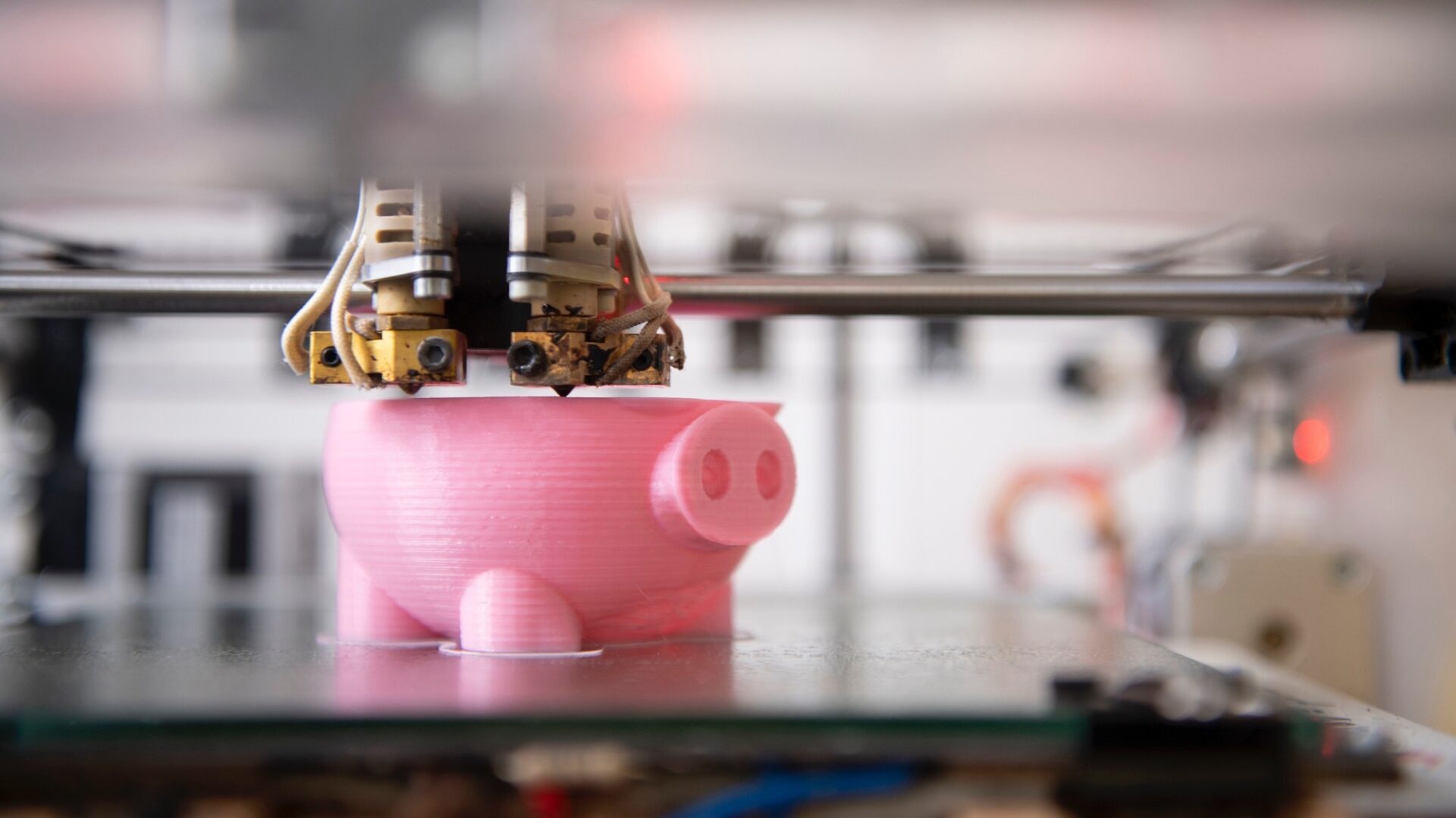
In one corner of a typical 3D printing workshop, failed prints and discarded support structures pile up like industrial kindling. The technology is supposed to be lean. produce only what you need, when you need it. But anyone who runs a printer knows the reality. Misprints, scaffolding, abandoned prototypes: they accumulate.
In a laboratory at the Korea Research Institute of Chemical Technology, a researcher is demonstrating something that makes that waste pile look like a design choice rather than an inevitability. He takes a freshly printed object from the printer and crushes it into a shapeless lump with his bare hands. Then he nonchalantly stuffs the lump back into the printer’s material container. Heat is applied. A new object emerges from the nozzle, smooth and clean. No grinding, no reprocessing into filament. Crush, load, print. That’s it.
The material isn’t some exotic synthetic resin. It’s sulfur—the yellowish industrial byproduct that piles up in literal mountains at oil refineries and natural gas plants. Roughly 85 million tons of sulfur pour out of refineries and smelters worldwide every year. Some of it is turned into sulfuric acid or fertilizer. But much of it just sits there in yellow mounds on factory grounds, waiting for a use.
4D printing using sulfur plastic as a raw material.Image: Korea Research Institute of Chemical Technology
A joint research team led by Dr. Kim Dong-Gyun of the Korea Research Institute of Chemical Technology, Prof. Wie Jeong-Jae of Hanyang University, and Prof. Kim Yong-Seok of Sejong University may have found one. Their paper, published as a cover article in Advanced Materials, suggests that sulfur can solve the chronic waste problem that has dogged 3D printing since its inception.
Dr. DongGyun Kim of KRICT, who led the study, and Jae Hyuk Hwang, a researcher at KRICT and the paper’s first author Image: Korea Research Institute of Chemical Technology
Why 3D printing materials are so hard to recycle
The problem starts at the molecular level. Common thermoplastics like PLA and ABS can technically be melted down and reused, but every time you reheat them, you’re breaking polymer chains. The material gets weaker and less elastic. Research has shown that recycled plastics can drop below usable performance thresholds after as few as three to five cycles. And that’s assuming you’re willing to grind down the failed print, melt it at high temperatures, and extrude it back into filament of uniform thickness—a process that is slow, energy-intensive, and rarely worth the trouble for small batches.
Photocurable resins are worse. When UV light hardens them, it forms irreversible covalent bonds between the molecules. The resulting material won’t melt. It won’t dissolve. There is no practical way to undo the chemistry and get the raw material back.
So the waste problem in 3D printing is really a chemistry problem. Once these materials harden, they’re locked into their final state. The Korea Research Institute team set out to find a chemical bond that can be locked and unlocked at will. A material that holds its shape when needed and breaks apart on command. They found one in sulfur.
A decade of trying to make sulfur useful
The idea of making plastic out of sulfur dates back to 2013, when Jeffrey Pyun’s team at the University of Arizona produced the first stable polymer in which sulfur made up more than half the material. The technique, known as inverse vulcanization, flipped the logic of conventional rubber processing. Normally, you add a small amount of sulfur to harden rubber. Pyun’s team made sulfur the main ingredient and added small amounts of organic compounds to hold it together.
Sulfur plastic Image: Korea Research Institute of Chemical Technology
The resulting material had unusual properties. It transmitted infrared light, making it a candidate for thermal imaging lenses. It could selectively absorb heavy metals like mercury from contaminated water. Over the following decade, labs around the world explored variations on the formula.
However, adapting sulfur plastic for 3D printing proved stubbornly difficult. The problem was structural. Inside the plastic, molecules were knotted into a mesh so tight that nothing could move through it. That density gave the plastic its strength. But it also made the material too viscous to push through a printer nozzle, even when melted. Researchers tried adjusting sulfur ratios and swapping in different organic crosslinkers, but the fundamental architecture of the network stayed the same. The mesh was too tight.
Loosening the mesh
Dr. Kim’s team took a different approach. Instead of tweaking ingredient ratios within the existing network framework, they redesigned the network itself. They deliberately loosened the crosslinked structure, spacing out the connections between molecular chains.
This was necessary because sulfur-sulfur bonds break and reform easily. Heat breaks them apart. As it cools they reconnect. In the old, tightly crosslinked structures, the effect was largely suppressed. The bonds didn’t have enough room to rearrange. In the looser network, those exchange reactions came alive. The practical payoff is a property called shear-thinning: When forced through a narrow opening, the material’s viscosity drops and it flows easily. Through the printer nozzle it flows like a liquid. Once extruded, the bonds reform and the shape holds.
Getting the looseness right was the hard part. Too loose, and the material loses its strength. With too little crosslinker the sulfur reverts to its elemental form. It unravels.
“Adding too little organic crosslinker makes the material overly flexible, and the sulfur ends up unraveling back to its original elemental form,” Dr. Kim said. “To maintain the desired properties, a certain minimum amount of crosslinker is required, so we went through a process of fine-tuning the ratios.”
Objects fabricated using sulfur-plastic-based 4D printing.Image: Korea Research Institute of Chemical Technology
Crush, load, print again
What makes this material genuinely different from conventional 3D printing plastics is what happens after printing. Because the sulfur-sulfur bonds are reversible, a finished print can be heated back into a soft, deformable state at any time. When it cools, the bonds reconnect and the material re-solidifies. The shape changes; the material doesn’t degrade. You can take a failed print or a structure that’s outlived its usefulness, crush it, stuff it back into the printer’s hopper, and print something new. No grinding. No filament reprocessing. The team confirmed that material properties remained stable through up to ten recycling cycles without significant degradation.
They called the process ‘closed-loop printing’. Sulfur that was once refinery waste becomes a printable plastic, gets shaped into a useful structure, and when that structure is no longer needed, gets melted down and printed into something else. At no point does the material leave the cycle as waste.
Printing robots without motors
Recyclability turned out to be only the beginning. The same dynamic bonds that make the material reusable also make it responsive. When exposed to heat or light, the bonds break and reform in ways that allow a printed structure to change shape and move according to a pre-designed pattern—a capability known as 4D printing, where objects continue to transform after they leave the printer.
By adjusting the sulfur content, the team could tune the temperature at which this shape-memory effect kicks in. At 46 percent sulfur, the material returns to its programmed shape at around 14°C. At 63 percent, the trigger temperature rises to about 35°C. At 76 percent, it’s roughly 52°C. Certain compositions also respond to near-infrared light. And when iron powder is mixed in, the material becomes magnetically responsive. Temperature, light, magnetic fields—different stimuli can be combined within a single printed object.
A 4D-printed object mixed with iron particles autonomously opening its lid and releasing its contents in response to a moving magnet.Image: Korea Research Institute of Chemical Technology
To demonstrate what this means in practice, the team printed several soft robots. None of them contain batteries, wires, or motors. They move entirely through the material’s own shape-memory response to external stimuli.
One was a thread-shaped underwater robot, just one millimeter thick, that rolled through water in response to magnetic fields. Robot cleared obstacles nearly 1.75 times its own body thickness. Another was a gripper robot that opened and closed its arms in response to ambient temperature changes. It could pick up and relocate small objects.
The most striking demonstration was a capsule-shaped robot designed to carry out a chemical reaction autonomously. The team loaded a catalyst inside a 3D-printed sulfur-plastic capsule and sealed it. When the capsule was dropped into an organic solvent solution and the temperature reached 50°C, the lid popped open on its own, releasing the catalyst. Simultaneously, a magnet rotating beneath the container spun the capsule like a magnetic stir bar, mixing the solution evenly. After about 60 minutes, the reaction was complete. Without anyone having to add the catalyst by hand or stir the solution.
What’s still missing
Commercialization is a long way off. The ten-cycle recycling figure is encouraging, but the team hasn’t yet run long-term tests beyond a few dozen cycles. More iron powder improves the magnetic response, but above 20 percent it clogs the nozzle. And no sulfur polymer material of any kind has yet reached commercial production.
“To move beyond lab-scale results and turn this into actual products, we need to target specific application areas and work with companies from the early stages,” Dr. Kim said.
A single material, many functions
“If you look at each element in isolation, there has been prior research,” Dr. Kim said. “For instance, studies using magnetic particles to build soft robots, or work demonstrating shape-memory properties with sulfur polymers—those individual component technologies already existed. But this is the first time all of these have been integrated into a single material that can deliver so many different functions at once.”
That integration is the real contribution. It is a material made from industrial waste. It is printable and fully recyclable. It can also be programmed to move, respond to its environment, and carry out tasks on its own. Each of those capabilities existed separately. Putting them together in one printable, crushable, re-printable substance is new.
The post How sulfur could fix 3D printing’s waste problem appeared first on Popular Science.
