
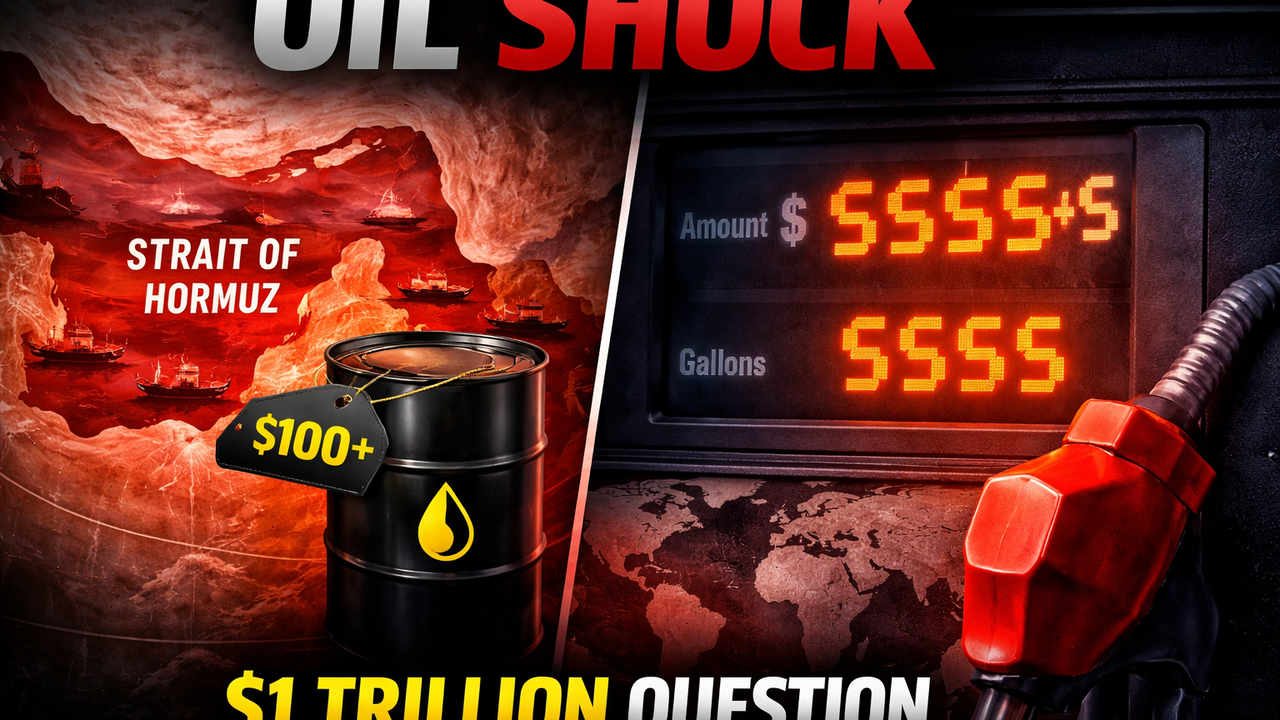
The updates on the Middle East crisis are beginning to sound less like a war bulletin and more like a bill, putting one more hole into the pocket. Oil is trading above $100 a barrel. Goldman Sachs has revised its 2026 US inflation forecast upward by 0.8 percentage points to 2.9% and slashed GDP growth projections by 0.3 points to 2.2%. In a worst-case scenario — a full month of disruption with crude averaging $110 a barrel — Goldman, according to Fortune, puts recession probability at 25%. The average price of a gallon of gas in the US jumped from $3.45 a week ago to $3.70 on Sunday, as per the SavingAdvice.com report. Inflation is being projected to hit 3.5 to 4 percent by mid-year.
Behind all of it sits one bottleneck: the Strait of Hormuz, 21 miles wide at its narrowest point, flanked on three sides by Iranian territory, and effectively closed to Western shipping since February 28.
Donald Trump has tried to bluster. He has tried pleading (like a boss!), and has got responses in NO. Germany has said the war “has nothing to do with NATO.” Italy struck a cautious note. European allies reacted warily to Trump’s demand that they help secure the strait or face a “very bad future.” Trump said Iran “wants to make a deal” but that the “terms aren’t good enough yet.” The claim has been denied outrightly by Tehran. Iranian Foreign Minister Abbas Araghchi told CBS News his nation “never asked for a ceasefire, and we have never asked even for negotiation.”
So if military force won’t work and diplomacy has stalled, what actually reopens the strait? One answer that is gaining reluctant traction in policy circles: Iran gets paid.
The $1 trillion question
Harlan Ullman, senior adviser at the Atlantic Council and the strategist who developed the “shock and awe” doctrine, has put the question bluntly. Writing in The Hill, he argues that the US will likely declare victory and stand down, letting Israel and Iran come to some accommodation. But he does not expect Iran to simply open the strait out of goodwill. It will, he writes, “extort a price.” And the Gulf states, having already redirected billions of dollars of oil exports through Saudi Arabia’s Petroline to Yanbu on the Red Sea, may find that paying Iran is cheaper than the alternative.
His analogy is pointed: Egypt charges for passage through the Suez Canal. Iran, Ullman suggests, could do the same for Hormuz — imposing tolls on transiting ships. The proceeds would be vast. The costs would be passed on to consumers. But it would still be better than sustaining the catastrophic impact of denying 20 per cent of global energy supply to markets indefinitely.
Would $1 trillion be too much? Ullman asks. Possibly not.
The military alternative has already hit its limits
The idea of forcing the strait open by military means has not been abandoned, but the obstacles are becoming harder to argue away. Reopening the Strait of Hormuz may be militarily possible, but it would likely be costly and time-consuming. Even attempting it could trigger a global economic shock. Persistent threats to shipping could take weeks or months to suppress, making long-term control impractical.
Iran does not need to sink ships. It only needs to convince insurers that it might. As foreign policy analyst Matthew Kroenig put it to NPR: “As long as Iran has drones and missiles and continues to fire them, I think many commercial shippers are going to think it’s just too dangerous even with an escort to pass through the strait.” Even after any ceasefire, uncleared mines could keep insurers — and thus tankers — away for months.
The amphibious invasion scenario — seizing the coastline around Bandar Abbas to choke off Iran’s ability to threaten shipping — has found support in Washington hawkish circles. Ullman did not mince his words about what it would actually require. He points to the Carter-era Rapid Deployment Joint Task Force, built in the late 1970s precisely for a Persian Gulf contingency, whose first commander, Gen. P.X. Kelley, openly joked that the force “was not rapid, deployable or joint.” Deploying a comparable corps of 150,000 troops today, with the strait already closed, would take months to stage. The 1945 Battle of Okinawa, where Japanese Kamikaze strikes caused catastrophic losses in amphibious operations, offers an uncomfortable historical parallel.
The economic clock is the real deadline
What makes the $1 trillion scenario more than theoretical is that the economic pressure is not abstract — it is landing in American households right now, and Trump’s domestic political base is not insulated from it.
The economically manageable window is probably closer to one or three months than to six months or more. That is not because the world would physically run out of oil after three months, but because the political and macroeconomic costs for vulnerable importers would likely intensify well before reserves were exhausted.
