
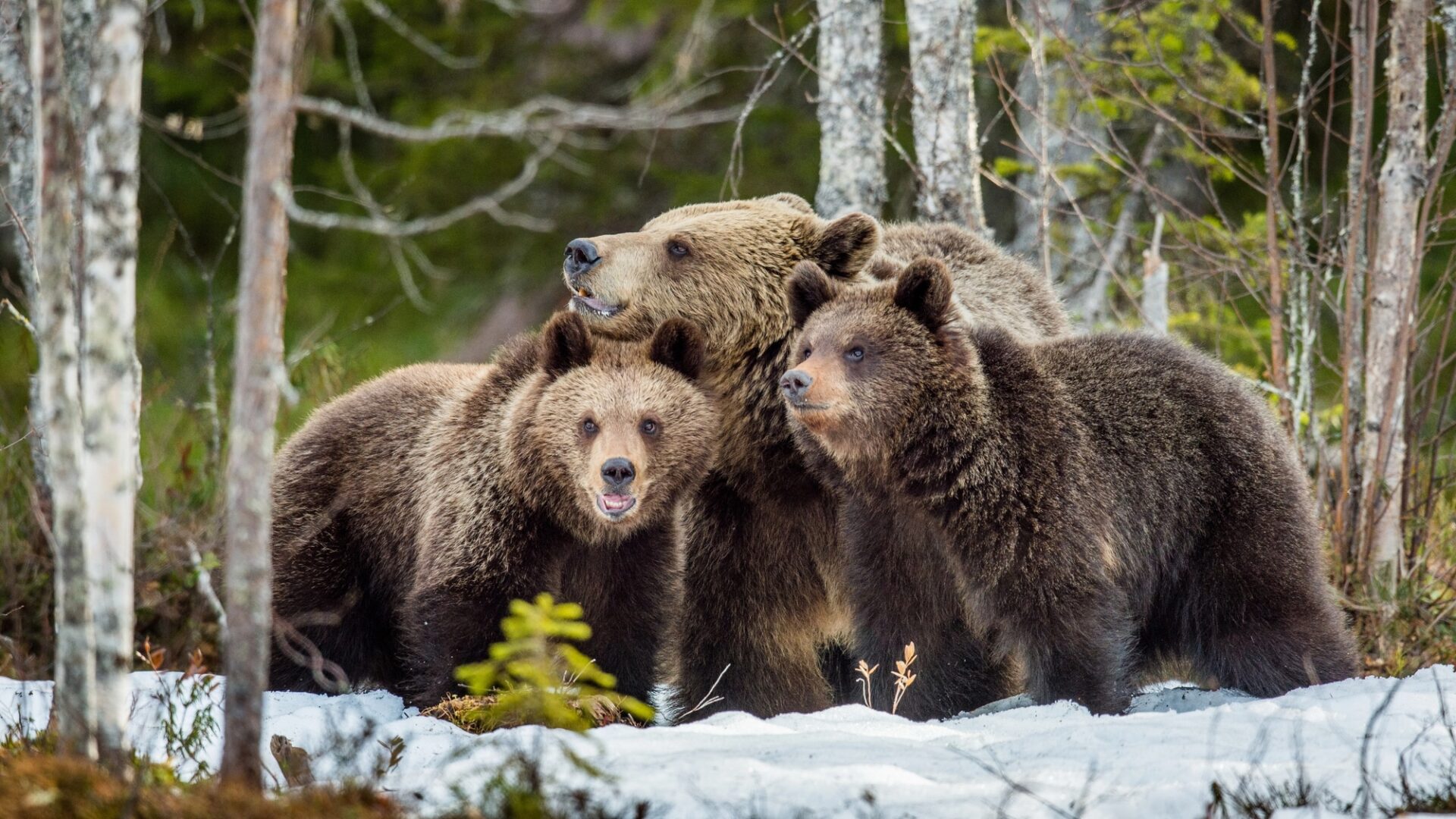
For most people, assessing a bear’s weight or fur color isn’t a top priority during an unexpected encounter in the woods. Instead, the desire to survive generally wins out over lingering to admire the predator’s sizable claws or snout shape. Knowing this, you’d be forgiven for having difficulty differentiating one bear from another.
For many ecologists, monitoring individual animals over long periods of time—even years—is crucial to conservation efforts. But even the experts easily get confused. This is especially true given a bear’s often dramatic, seasonal weight fluctuations, as well as how physically different they may look pre- and post-hibernation. To help wildlife biologists make sense of it all, a team at Switzerland’s EPFL and Alaska Pacific University (APU) has developed PoseSwin, a machine learning program capable of telling brown bears apart from one another. The technology was recently detailed in a study recently published in the journal Cell Current Biology.
PoseSwin was trained on over 72,000 photos of 109 different brown bears taken by APU researcher Beth Rosenberg between 2017 and 2022. Rosenberg captured the images at all times of day and night and in various weather conditions, while also making sure to document the bears in a variety of behaviors. She and her colleagues then relied on their existing knowledge of brown bear physiology to determine the handful of anatomical details that remain relatively constant over the animal’s life. These features include their brow bone angle, ear placement, and muzzle shape. Next, they incorporated data on how bears looked in different poses and at varying angles.
“Our biological intuition was that head features combined with pose would be more reliable than body shape alone, which changes dramatically with weight gain,” explained Alexander Mathis, a project collaborator and researcher at EPFL’s Brain Mind Institute and Neuro-X Institute. “The data proved us right—PoseSwin significantly outperformed models that used body images or ignored pose information.”
From there, the team took PoseSwin for a field test with help from citizen scientists. After amassing more brown bear portraits from visitors to Katmai National Park and Preserve (home of Fat Bear Week), researchers fed the photos into the machine learning program. In multiple cases, PoseSwin successfully matched individual bears to those already in its database. Already, PoseSwin’s designers could begin to track how and where these predators moved in search of seasonal food.
“This is a concrete example of the PoseSwin model’s potential,” said Rosenberg. “The technology could eventually be used to analyze the thousands of pictures that visitors take every year and help to build a map of how brown bears use this expansive area.”
Rosenberg and her colleagues are now using PoseSwin to monitor over 100 bears living around McNeil River State Game Sanctuary without disrupting their daily habits. In doing so, they should gain more accurate information on the bears’health and wellbeing, providing a much needed boost to conservation efforts.
“Bears are at the top of the food chain and ensure the proper functioning of their ecosystem. They are critical to maintaining healthy systems,” explained Rosenberg.
PoseSwin likely won’t remain so bear-centric. Early benchmark tests indicate it’s also incredibly accurate when trained on macaques, suggesting it could soon expand to handle many other species. The machine learning algorithm is also available open-source, so anyone can access it for their own subject—although there’s a good chance none of them will be harder for PoseSwin to identify.
“Bears are perhaps the hardest species to recognize individually,” said Mathis. “We focused on them first with the idea that our program could be adapted to other species, from mice to chimps.”
The post Facial recognition AI trained to work on bears appeared first on Popular Science.
Facial recognition AI trained to work on bears
